Real EstateOctober 8, 2026
JVC vs JVT: Which Is the Better Investment?
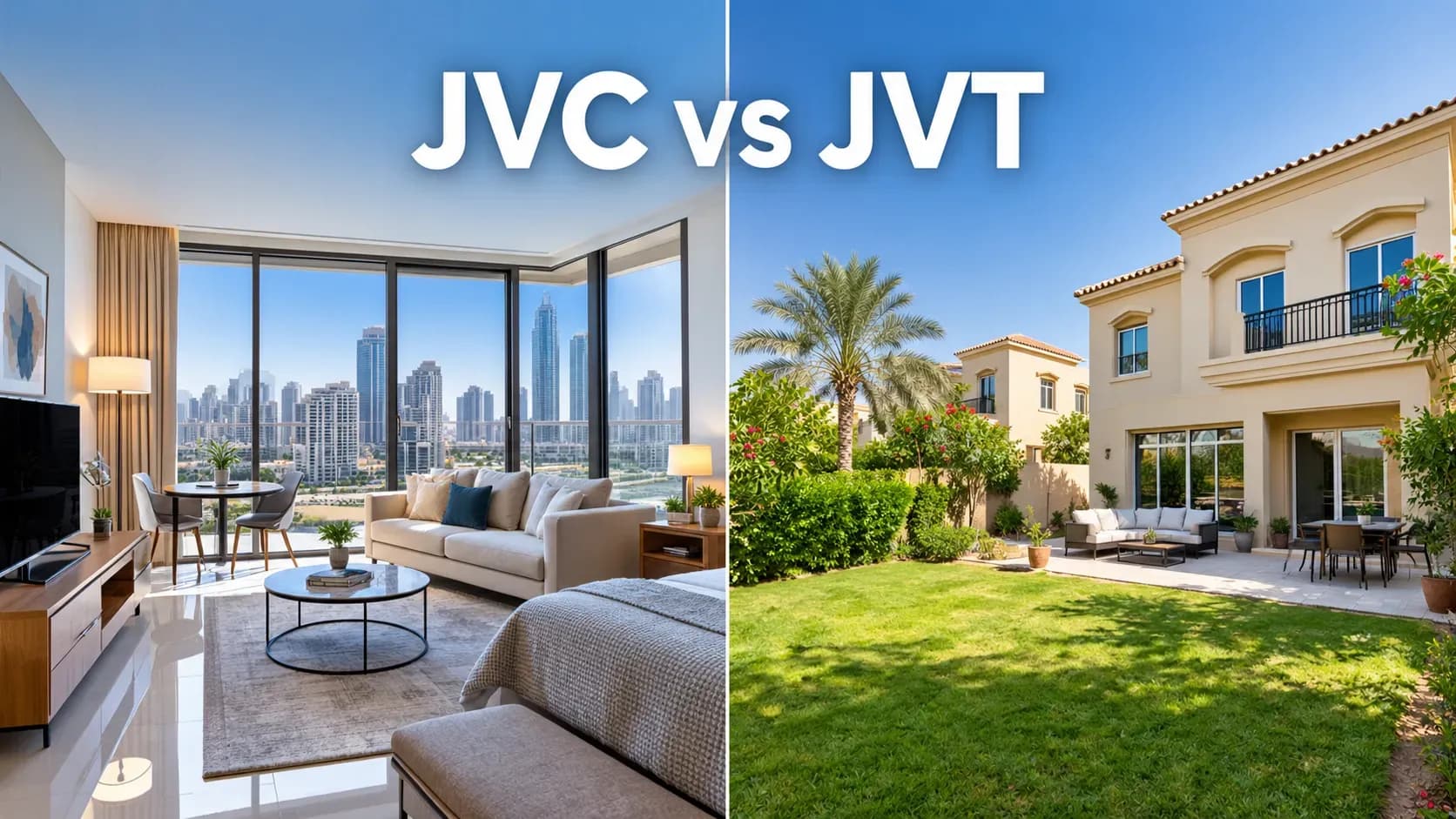
Walk into any Dubai property conversation and someone will say "I'm looking at JVC or JVT." The two communities sit in the same Jumeirah Village corridor, they're both freehold, both attract investors, and both have studios starting under AED 1 million. So why doesn't everyone just pick the cheaper one and call it done?
Because the cheaper one might give you lower yields, and the slightly more expensive one might lock you into higher service charges. The real difference isn't the price tag. It's who each community works for, and what they'll actually put back in your pocket over the next five to seven years.
Quick Answer
JVC (Jumeirah Village Circle) offers stronger studio yields and lower service charges, making it ideal for yield-focused investors who don't mind supply pressure and rent growth below 3%. JVT (Jumeirah Village Triangle) yields 50-100 basis points higher on apartments and villas, suits family buyers and medium-hold investors, and has more stable tenant demand, but service charges run AED 4-8/sqft higher, which can erase that yield advantage.
Key Takeaways
- JVC (Jumeirah Village Circle) had 16,785 apartment transactions in 12 months to June 2026, the highest mid-market volume in Dubai, with studios yielding 7-8.5% on lower service charges.
- JVT (Jumeirah Village Triangle) yields typically 50-100 basis points higher on equivalent units, but service charges of AED 12-18/sqft (vs JVC's 8-15) can wipe out the advantage if you focus on net yield.
- JVC suits volume-driven, 3-7 year hold investors; JVT suits stable, family-anchored, 5-7 year hold investors.
- The Blue Line metro to JVC opens in 2029, a potential capital catalyst, while JVT already has Dubai Marina metro access 12 minutes away.
- New-let rents in JVC are expected to grow at 0-3% annually; JVT has more stable tenant demand and less new supply pressure.
JVC vs JVT: The Basic Differences
Both communities are freehold, both are part of the broader Jumeirah Village area, and both attract investors. But they're built for different buyer profiles.
Feature | JVC | JVT |
|---|---|---|
Developer | Nakheel | Nakheel |
Size and setup | Large (870 hectares), high-volume, multiple phases | Smaller, more established, family-focused |
Metro access | None currently; Blue Line station 2029 | Dubai Marina Red Line, 12 minutes by car |
Property types | Studios, 1-4BR apartments, townhouses, villas | Apartments (studios to 3BR), villas |
Main tenant base | Young professionals, young families, budget renters | Families, school-anchored, stable renters |
Supply status | Largest off-plan pipeline of comparable communities | Less new inventory pressure |
Tenant turnover | High | Lower |
Why both are called "Jumeirah Village" but serve different investors
Nakheel developed both communities in the same outer Dubai growth corridor. The name "Jumeirah Village" is brand recognition. But JVC is Nakheel's high-volume, diverse play: apartments, townhouses, and villas at every price point, built to move units fast. JVT is more curated: family villas and apartments, built around schools, parks, and retail, with less turnover and a more stable rental market. For detailed investor analysis on each community, Oliva's JVT 2026 investor guide breaks down the numbers. Think of JVC as the efficient apartment factory, and JVT as the family destination.
Rental Yields: JVT's Advantage, If Service Charges Don't Erase It
This is where the numbers get interesting.
Property type | JVC yield | JVT yield | Difference |
|---|---|---|---|
Studio | 7-8.5% | 6.5-8% | Even, JVC slightly higher |
1-bedroom apartment | 7-8% | 6.5-8% | JVT typically +50-100 bps |
2-bedroom apartment | 6-7.5% | 6.5-8% | JVT typically +50-100 bps |
Villa (3-4BR) | 5-6.5% | 5-6.5% | Even, depends on unit |
On paper, JVT wins. But here's the catch: those gross yields don't account for service charges, which run higher in JVT. House & Hedges' JVC investor analysis highlights this exact trade-off in detail.
The service charge issue
Service charges in JVC run AED 8-15/sqft/year. In JVT they're AED 12-18/sqft/year. On a typical 2-bedroom apartment of 1,200 sqft, that's a difference of AED 4,800 to AED 3,600 annually, or about AED 400-300/month.
Let's run the math on a 1-bedroom apartment yielding 7% gross (AED 80,000 annual rent on a AED 1.14M purchase):
- JVC scenario: Service charge AED 10/sqft on 700 sqft = AED 7,000/year. Net yield: (80,000 - 7,000) / 1,140,000 = 6.4%
- JVT scenario: Service charge AED 15/sqft on 750 sqft = AED 11,250/year. Net yield: (80,000 - 11,250) / 1,300,000 = 5.9%
The gross yield advantage disappears. This is why you need to stress-test service charges before you buy, especially in JVT.
Capital Appreciation: JVC's Blue Line Catalyst vs JVT's Stability
The 2029 Blue Line station at JVC is a big deal. New metro access typically drives capital appreciation, as Dubai has shown with every line extension. JVC prices could jump 10-20% in the years around the opening, and rents could follow. For a broader view of how infrastructure impacts appreciation, our guide on how infrastructure projects increase property values in Dubai walks through the mechanics.
JVT already has metro access and has posted solid appreciation (reported median price growth of +50% from 2021 to 2025, though this is a brokerage claim and should be verified against DLD data). That growth is steady but not explosive.
For short-term appreciation (3-5 years): JVC has the Blue Line upside.
For long-term stability and gentle growth (5-10 years): JVT's family demand and lower supply pressure provide more predictable appreciation.
Tenant Profile and Rental Demand
JVC tenants are mobile: young professionals, young families in their first Dubai rental, budget-conscious renters trading down from pricier areas. They rent for 1-3 years, then move up or move out. That's great for yields if you keep units consistently rented, but it means more vacancy between tenants and more marketing costs.
JVT tenants are stickier: families with kids in schools, established expats, people who settle in. Average lease length is longer, and they're less price-sensitive than JVC renters, so you have more room to hold firm on rent if the market softens.
For a yield investor, JVC's high turnover can be an advantage if you're active. For a passive hold-and-collect investor, JVT's lower churn means fewer costly vacancy gaps. Understanding how tenant profile affects your investment is crucial, and our breakdown of best family communities in Dubai shows why JVT's stability matters.
JVC vs JVT: Which Suits Your Investment Goal?
For pure rental yield
Winner: JVT by a narrow margin, if you account for service charges. Studios in JVC are competitive, but 1BR and larger units in JVT edge out the yield math once you factor in higher service charges. However, the margin is small (50-100 bps), so don't pick JVT just for yield without checking building-specific service charges first.
For capital appreciation
Winner: JVC. The Blue Line catalyst is real. If you believe metro access drives 15-20% appreciation over 3-5 years, that beats JVT's slower, steady growth. But this is a timed bet: you need to sell before or during the hype. Hold it too long and you're left with a normal community.
For stability and peace of mind
Winner: JVT. Less supply pressure, more stable tenant demand, established schools and retail. You're not timing a market catalyst; you're buying a community that works as-is.
For high-volume trading
Winner: JVC. 16,785 transactions in 12 months means liquidity and price discovery. You can exit quickly if you need to.
For buy-and-hold, five-to-seven-year hold
Winner: JVT by a point. Lower turnover, higher net yields (if service charges are managed), and you avoid the timing risk of the Blue Line hype.
The Hidden Costs: Chiller Status and Timing
Before you commit to either community, check whether a building is chiller-free or district-chilled. Chiller-free buildings are cheaper to run, which means lower service charges and higher net yields. But they're noisier and less appealing to some tenants, which can drag on rent.
Also: in JVC, the advantage of lower service charges is real today, but it may not last. Once the Blue Line opens and development intensifies around the station, JVC's service charges could rise to match JVT's. Buy now, and lock in the lower charges; buy later, and you'll pay more.
In JVT, you're already paying the higher charges, but you get the benefit of a stable, mature community from day one.
Frequently Asked Questions
What's the difference between JVC and JVT in Dubai?
JVC is a large, high-volume community with diverse property types and strong studio yields. JVT is a smaller, family-oriented community with slightly higher per-unit yields but higher service charges. Both are freehold and in the Jumeirah Village area.
Which has better rental yields: JVC or JVT?
JVT yields about 50-100 basis points higher on 1-bedroom and larger apartments. But JVC's lower service charges narrow the gap. On net yield, they're almost even; the difference depends on individual building service charges.
Should I buy a villa in JVC or JVT?
Both offer similar villa yields around 5-6.5%. The choice depends on whether you want the Blue Line appreciation upside (JVC) or family-focused tenant stability (JVT). Villas in either community are a longer-term hold than apartments.
Is JVT more expensive than JVC?
On a per-sqft basis, JVT runs about AED 200-400/sqft higher for apartments. Absolute prices are similar for comparable units, but JVT villas command a premium due to the family market.
Which community is better for a family: JVC or JVT?
JVT is built for families: schools, parks, and stable neighbors. JVC has families too, but it's more transient. For a family planning to stay 5+ years, JVT is more comfortable.
Choose Based on Your Timeline, Not Just the Yield Table
JVC and JVT aren't better or worse. They're built for different people. If you're yield-focused and can handle supply pressure, JVC's studios and lower service charges work. If you want stability, family amenities, and slightly higher net returns on a larger unit, JVT is worth the extra AED 4-8/sqft in service charges.
The real mistake is picking JVC because it looks cheaper, then getting stuck with a vacant unit during the market soft patch before the Blue Line opens. Or picking JVT expecting 8% gross yield, then discovering service charges cut it to 6%.
Run the net-yield numbers for the specific building you're eyeing, check the tenant profile against your plans, and decide. That's what BuyHomeDubai helps you do: choose with your eyes open.

Dubai Real Estate
Ready to find your
dream home in Dubai?
Browse thousands of properties across Dubai's most sought-after neighbourhoods. Our experts are ready to guide you.