Real EstateSeptember 1, 2026
Signs a Dubai Property Is Undervalued
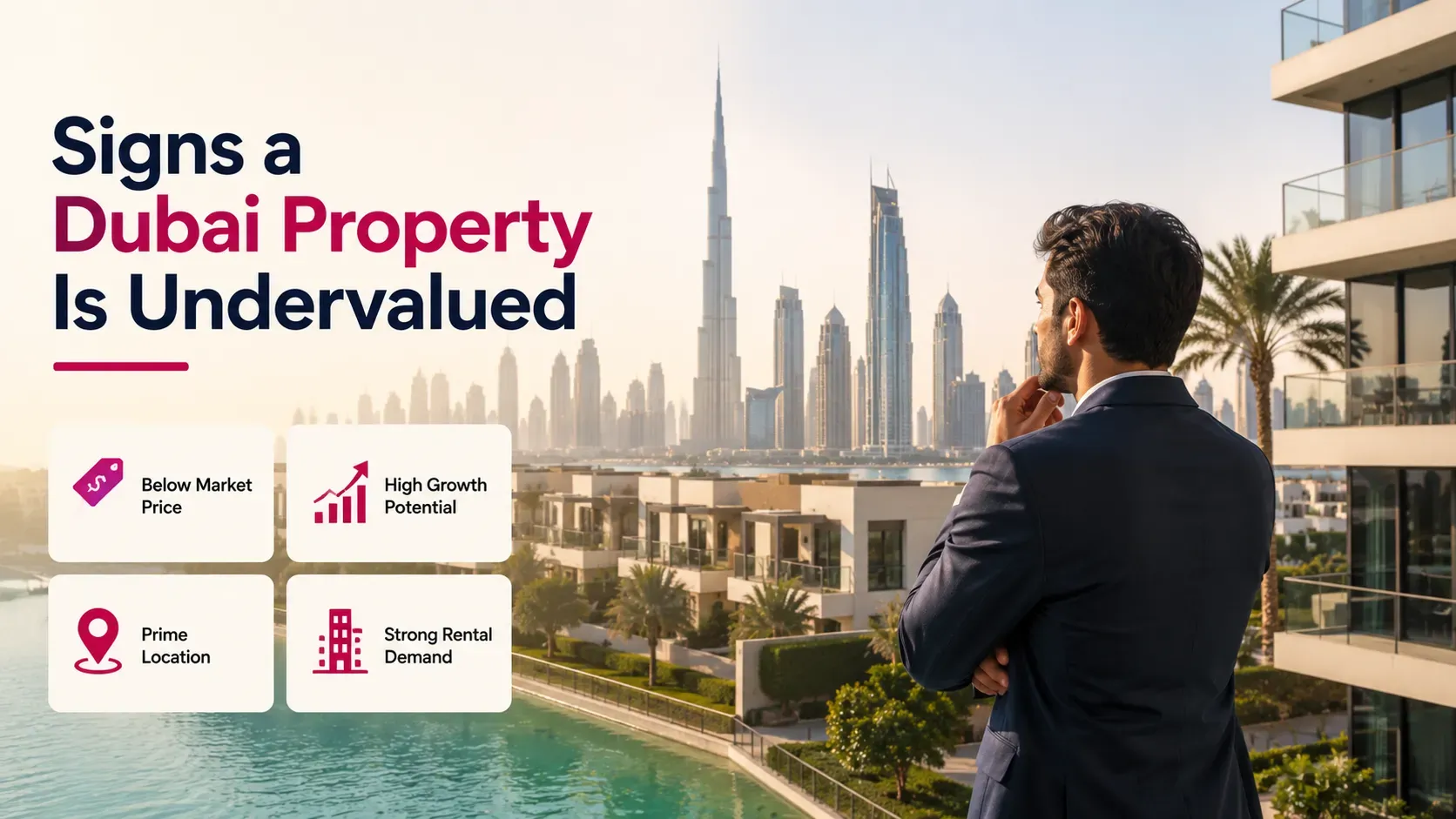
Finding an undervalued property can be one of the most attractive opportunities for a Dubai property investor. But a low asking price does not automatically mean a property is a bargain.
A property may be cheap because it needs major repairs, has weak rental demand, carries high service charges or is located in an area facing significant new supply.
The real opportunity comes when a property is priced below what its location, condition, rental potential and comparable transactions suggest it may be worth.
Dubai's property market is also becoming more selective. Recent market reporting indicates that buyers are increasingly focusing on value, while additional housing supply is creating different conditions across individual locations and property segments.
That makes property-level research particularly important.
Signs a Dubai Property Is Undervalued
An undervalued property usually shows a combination of positive fundamentals and a price that appears low compared with similar properties.
Some potential signs include:
- A lower price per square foot than comparable properties
- Strong rental demand
- Attractive rental yield
- Good location
- Quality amenities
- Limited competing supply
- Renovation potential
- Strong resale demand
- A motivated seller
- Recent comparable transactions at higher prices
No single sign proves that a property is undervalued.
Instead, investors should combine several indicators before making a decision.
Dubai Land Department's real estate data provides information on transactions, rents, valuations, property sizes, locations and property types, making it a useful starting point for this type of comparison.
The Property Is Priced Below Similar Properties in the Same Area
One of the simplest ways to identify a potentially undervalued property is to compare it with similar properties nearby.
Suppose two apartments have similar:
- Size
- Number of bedrooms
- Building age
- Floor
- Amenities
- Parking
- View
- Condition
If one is consistently priced significantly lower than comparable units, it deserves further investigation.
The important word is comparable.
Comparing a basic apartment in an older building with a premium unit in a newer development will not provide a useful valuation.
Dubai Land Department's transaction database allows users to examine property transactions by area, property type, size and other characteristics.
This provides a better basis for determining whether an asking price is genuinely unusual.
The Rental Yield Is Higher Than Comparable Dubai Properties
Rental performance can provide another clue.
If two properties have similar purchase prices but one consistently achieves stronger rent, it may offer better value for an investor.
For example:
Property A
Purchase price: AED 1 millionAnnual rent: AED 55,000
Property B
Purchase price: AED 1 millionAnnual rent: AED 70,000
Property B may deserve closer attention, although investors still need to investigate service charges, maintenance, vacancy and other expenses.
DLD's Rental Index allows users to calculate average rental information based on the property and location, making it useful when checking whether expected rental income is realistic.
A strong rental yield is not proof of undervaluation, but it can be an important supporting indicator.
The Property Has Strong Rental Demand but a Low Purchase Price
An undervalued property does not necessarily need to be in Dubai's most expensive neighbourhoods.
What matters is the relationship between price and demand.
A relatively affordable apartment can be attractive if:
- Tenants actively search for properties in the area
- Units are rented quickly
- The location has good transport links
- Nearby employment centres support demand
- Schools and amenities attract residents
- Rental prices remain competitive
DLD's rental data can help investors compare actual rental activity rather than relying only on advertised rents.
This is especially important because a low purchase price means little if the property remains vacant for long periods.
Recent Transactions Suggest the Asking Price Is Too Low
The asking price is not necessarily the market value.
A seller may list a property below comparable recent transactions because they:
- Need to sell quickly
- Are relocating
- Need liquidity
- Have already purchased another property
- Want to complete the sale quickly
If similar properties have recently sold for more, the difference deserves investigation.
However, investors should compare actual transactions rather than relying on other asking prices.
DLD's official real estate database includes transaction amounts, transaction dates, property sizes, locations and property types.
This makes completed transactions more useful than simply browsing online listings.
The Property Has a Better Location Than Its Price Suggests
Location remains one of the most important factors in property value.
A property may be worth investigating if it offers stronger location advantages than its price indicates.
Consider:
- Metro access
- Major road connections
- Proximity to business districts
- Schools
- Hospitals
- Shopping centres
- Restaurants
- Beaches
- Parks
- Future infrastructure
Two apartments with similar specifications can have significantly different values because of their surroundings.
The key is to determine whether the market has already priced the location advantage into the property.
If not, there may be an opportunity.
The Property Has Renovation Potential
Sometimes a property appears cheaper simply because it is outdated.
That does not automatically make it undervalued.
Calculate the complete renovation cost first.
For example:
Purchase price: AED 900,000Renovation: AED 70,000Total investment: AED 970,000
If comparable renovated properties are selling for around AED 1.1 million, the property may deserve further investigation.
But if renovation costs eventually reach AED 180,000, the apparent discount may disappear.
Investors should therefore obtain realistic repair and renovation estimates before considering an older property a bargain.
A Property Inspection Checklist Before Buying can also help identify issues that may affect the true cost of acquisition.
The Property Has Better Features Than Comparable Units
Features can sometimes be overlooked in a property's asking price.
For example, a unit may have:
- A larger balcony
- Better views
- Higher floor
- Additional parking
- Larger layout
- Better natural light
- Upgraded interiors
- Better orientation
- Direct access to amenities
These features may make the property more desirable to tenants and future buyers.
However, investors should determine whether the premium is actually reflected in rental income or resale demand.
A feature is valuable when buyers or tenants are willing to pay for it.
The Property Is Being Sold Below Its Previous Market Value
A property's previous transaction price can provide useful context.
Suppose a property was purchased several years ago at a significantly higher price and is now being offered below comparable properties.
That may indicate an opportunity.
But it may also indicate that:
- The building has deteriorated
- The area has changed
- Rental demand has weakened
- Service charges have increased
- New supply has affected demand
- The previous owner overpaid
Historical price alone should therefore never be used to determine current value.
The more useful question is:
What is the property worth today compared with similar properties?
The Property Has Strong Resale Potential
An undervalued property should ideally have more than one possible exit strategy.
Consider whether the property would appeal to:
- Investors
- First-time buyers
- Families
- Professionals
- Long-term tenants
- Short-term rental operators, where permitted
A property with a broad potential buyer and tenant pool may be easier to resell.
Location, layout, condition, building quality and ongoing costs all influence this potential.
A property that is cheap but difficult to sell may not be a particularly attractive investment.
A Low Price Is Not Always a Sign of an Undervalued Property
This is one of the most important points.
A cheap property can be cheap for a reason.
Potential warning signs include:
High Service Charges
High recurring costs can reduce net rental returns.
Poor Building Condition
Major repairs can quickly eliminate the apparent discount.
Weak Rental Demand
A low purchase price does not compensate for persistent vacancy.
Excessive New Supply
Large numbers of competing properties can put pressure on rents and resale prices.
Poor Accessibility
A property far from transport and major amenities may have limited tenant demand.
Difficult Resale
Some properties have a narrow buyer pool.
Legal or Documentation Issues
Ownership and property documentation should always be properly verified before proceeding.
Poor Layout
A large property is not necessarily valuable if the layout is inefficient.
This is why investors should investigate the reason behind a low price before calling a property undervalued.
How to Check if a Dubai Property Is Really Undervalued
A practical valuation process can be divided into several steps.
Step 1: Find Comparable Properties
Identify properties with similar size, type, age, location and condition.
Step 2: Compare Actual Transactions
Look at completed transactions rather than relying only on asking prices.
Step 3: Calculate Price Per Square Foot
Compare the property with similar units on a like-for-like basis.
Step 4: Check Rental Potential
Use DLD rental information to assess whether the expected rent is realistic.
Step 5: Calculate Net Yield
Subtract realistic expenses from gross rental income.
Step 6: Inspect the Property
Identify maintenance, renovation or structural issues.
Step 7: Research the Building
Look at service charges, management, amenities and building condition.
Step 8: Study Future Supply
New developments can affect both rental and resale demand.
Step 9: Consider the Exit Strategy
Ask who is likely to buy or rent the property in the future.
Step 10: Negotiate
If your research supports a lower value, use evidence rather than simply asking the seller for a discount.
Dubai Property Undervaluation Checklist
Factor | What to Check |
|---|---|
Purchase price | Compare with similar units |
Price per sq. ft. | Compare with recent transactions |
Rental income | Check realistic market rent |
Rental yield | Calculate gross and net yield |
Location | Transport, amenities and demand |
Condition | Maintenance and renovation costs |
Service charges | Check recurring ownership costs |
Building | Age, management and quality |
Supply | Upcoming competing properties |
Resale | Potential future buyer demand |
Documentation | Verify ownership and property records |
Exit strategy | Decide how you could eventually sell |
DLD provides official services covering property transactions, valuations, rental information and property-related records, making official data an important part of the research process.
Frequently Asked Questions About Undervalued Properties in Dubai
What makes a Dubai property undervalued?
A property may be considered potentially undervalued when its price appears lower than comparable properties despite having similar or stronger fundamentals such as location, condition, rental demand and resale potential.
How can I find undervalued property in Dubai?
Compare recent transaction prices, price per square foot, rental income, service charges, property condition and location. DLD's real estate data can provide transaction and valuation information for this analysis.
Is a low property price always a good investment?
No. A low price may reflect poor condition, weak rental demand, high service charges, oversupply or resale difficulties.
How does rental income help identify an undervalued property?
If a property produces relatively strong rental income compared with its purchase price and similar properties, it may deserve further investigation. Rental performance should still be evaluated after expenses.
Can an old property be undervalued?
Yes, but age alone does not determine value. An older property may offer an attractive price if its location and rental demand remain strong. Renovation and maintenance costs must be included in the analysis.
Should I compare asking prices or completed transactions?
Completed transactions are generally more useful for determining market value because asking prices represent what sellers want rather than what buyers have actually paid. DLD's database includes transaction amounts and property details.
Does location affect whether a property is undervalued?
Yes. Access to transport, employment centres, schools, amenities and other infrastructure can significantly affect rental and resale demand.
Can market conditions create undervalued properties?
They can create opportunities where sellers adjust prices faster than the underlying fundamentals of a property change. However, investors should investigate whether the lower price reflects a temporary market condition or a permanent weakness.
Final Thoughts
Finding an undervalued property in Dubai is less about finding the cheapest property and more about finding a property whose price does not fully reflect its underlying fundamentals.
A potentially attractive opportunity may have a lower price than comparable properties, strong rental demand, a good location, manageable ownership costs and reasonable resale potential.
Dubai's market is currently becoming more selective, with analysts highlighting differences between locations, property types and supply conditions rather than treating the emirate as one uniform market.
That makes detailed research increasingly important.
DLD's official real estate database provides transaction, rental and valuation information, while its Rental Index can help investors assess average rental levels.
Before calling a property undervalued, investigate the numbers, inspect the property and understand why the seller is offering it at that price.
The best opportunity is not necessarily the property with the biggest discount.
It is the property where the price, rental potential, location, condition and future demand create a favourable balance.
For more Dubai property investment guides and buying insights, visit Buy Home Dubai.

Dubai Real Estate
Ready to find your
dream home in Dubai?
Browse thousands of properties across Dubai's most sought-after neighbourhoods. Our experts are ready to guide you.