Real EstateSeptember 1, 2026
Signs a Dubai Property Is Overpriced
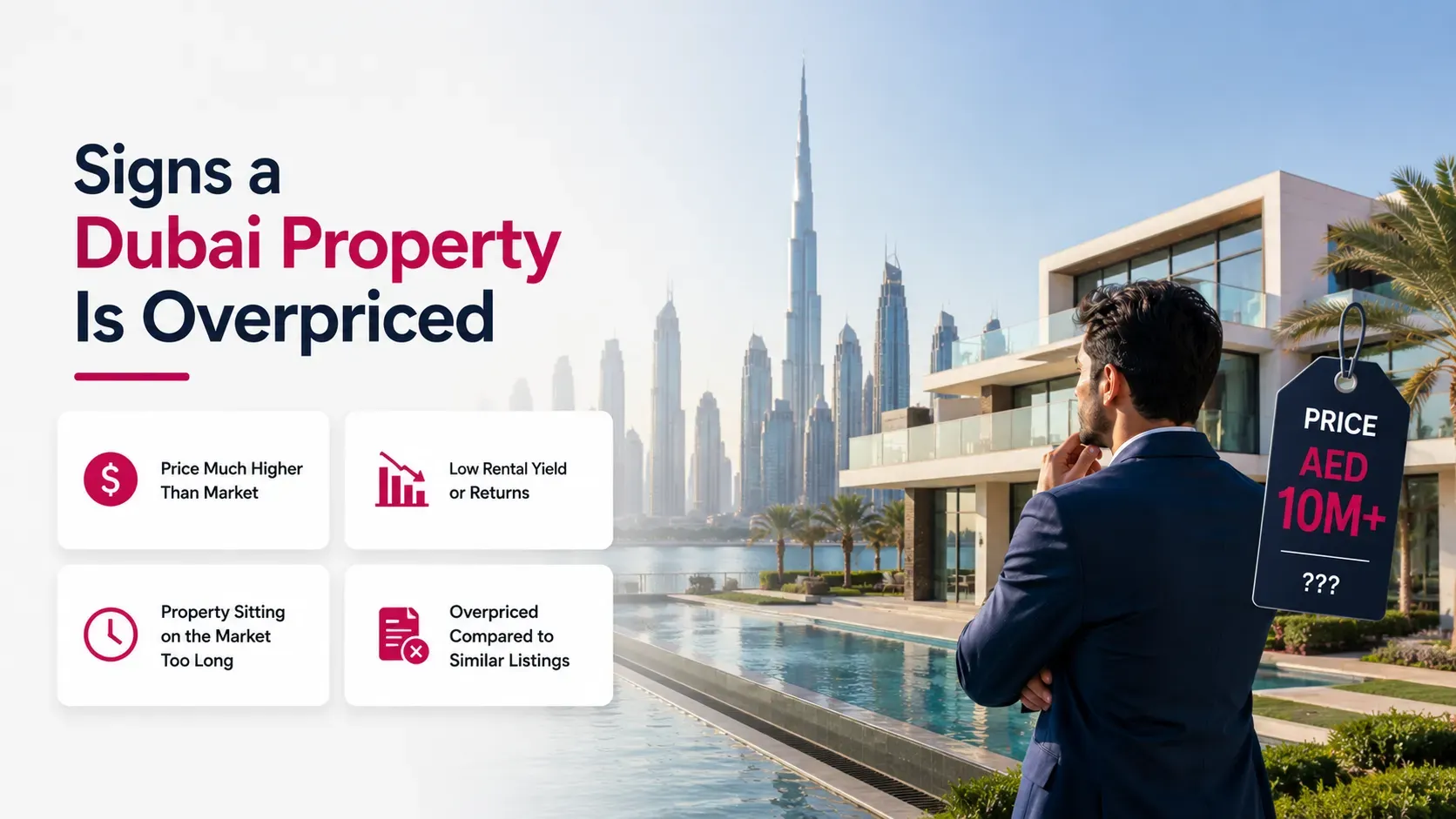
A high asking price does not automatically mean a Dubai property is overpriced. A premium apartment may justify a higher price because of its location, views, layout, building quality, amenities or scarcity.
The problem occurs when the asking price is significantly higher than what the property's comparable transactions, rental potential, condition and location can reasonably support.
This distinction matters in Dubai's current market. Residential property remained active during H1 2026, with 80,509 residential properties sold for AED 226.5 billion, but buyers became more selective about location, quality, developer reputation and pricing.
July 2026 data also shows why buyers should avoid relying on broad market headlines alone. A DLD-based residential price index recorded a 2.6% year-on-year decline in July, while villas were up 1.7% and apartments were down 3.3%, demonstrating that different property segments can behave very differently.
For buyers and investors, the key question is therefore not simply "Is this property expensive?"
It is:
"Does the property's price make sense compared with what similar properties are actually achieving?"
Signs a Dubai Property Is Overpriced
There are several warning signs that can indicate an asking price deserves closer examination.
These include:
- A price significantly above comparable properties
- An unusually high price per square foot
- Weak rental returns
- Low rental demand
- High service charges
- Expensive maintenance requirements
- A premium based mainly on future expectations
- Similar properties selling for less
- A property sitting on the market for an unusually long time
- Features that do not justify the additional price
One sign alone does not prove that a property is overpriced.
A luxury apartment, for example, may have a higher price per square foot because it offers a superior location or unique features.
The strongest indication comes when multiple warning signs appear together.
The Asking Price Is Higher Than Similar Properties
One of the easiest ways to identify potential overpricing is to compare the property with similar units.
Look for properties with comparable:
- Location
- Property type
- Size
- Number of bedrooms
- Building age
- Floor
- Condition
- Parking
- Amenities
- Views
Dubai Land Department's real estate database provides transaction information including transaction amount, property size, area, property type, rooms, parking and nearby landmarks.
This makes actual transaction data more useful than simply comparing online asking prices.
For example, if similar apartments in the same building have recently sold around AED 1.2 million while a comparable unit is listed for AED 1.45 million, the premium needs to be explained.
Perhaps the unit has a better view or a superior renovation.
If there is no meaningful difference, the asking price may be difficult to justify.
The Price per Square Foot Is Above Recent Transactions
Total purchase price can sometimes hide an inflated valuation.
A better comparison is often price per square foot.
For example:
Property A: AED 1.2 million / 800 sq. ft.Price: AED 1,500 per sq. ft.
Property B: AED 1.5 million / 800 sq. ft.Price: AED 1,875 per sq. ft.
If both properties are otherwise very similar, Property B requires a clear explanation for its 25% higher price per square foot.
DLD transaction data includes both transaction amounts and property sizes, allowing buyers to perform this type of comparison.
However, price per square foot should not be used in isolation.
A higher figure may be justified by:
- A premium floor
- Better views
- A newer building
- Superior finishes
- Better amenities
- A more desirable location
- Greater scarcity
The comparison must always be like-for-like.
The Property Has a Low Rental Yield for Its Purchase Price
Investors should pay close attention to rental yield.
Suppose two similar apartments generate approximately the same annual rent.
If one costs significantly more to purchase, its rental yield will be lower.
For example:
Property A
Purchase price: AED 1 millionAnnual rent: AED 65,000Gross yield: 6.5%
Property B
Purchase price: AED 1.3 millionAnnual rent: AED 65,000Gross yield: 5%
Property B may still be the better investment if it has superior capital-growth potential, location or quality.
But the investor should understand exactly why they are paying the additional AED 300,000.
Dubai Land Department's Rental Index allows users to check average rental information based on property type, area and number of rooms.
That can help buyers determine whether the rental income being used to justify a property price is realistic.
The Seller Is Pricing the Property Based on Future Expectations
Another warning sign is a seller who focuses heavily on what the property might be worth in the future.
Future infrastructure, new transport connections, upcoming attractions and planned developments can influence property values.
But future potential should not completely replace current fundamentals.
Be cautious if the valuation depends mainly on statements such as:
- "Prices will double after completion."
- "This area will become the next Downtown."
- "A major development is coming."
- "You will easily sell it for much more later."
Future growth is possible, but it is not guaranteed.
A sensible valuation should still make sense based on today's property characteristics, transactions, rental demand and ownership costs.
The Property Has Features That Do Not Justify the Premium
Some properties are marketed using impressive features that may not justify a substantial price difference.
Examples include:
- Luxury furniture
- Designer interiors
- A swimming pool
- Smart-home technology
- A large balcony
- High-floor positioning
- Partial views
- Branded appliances
These features can add value.
The question is how much value they add.
A renovated apartment costing AED 200,000 more than comparable units may not be attractive if the renovation itself cost only AED 50,000 and does not produce additional rental income or meaningful resale demand.
Always ask:
Would buyers or tenants actually pay more for this feature?
If not, the feature may be more marketing than investment value.
The Location Does Not Support the Asking Price
Location is one of the biggest factors influencing Dubai property prices.
A property can look attractive online but become less appealing when you examine its actual surroundings.
Consider:
- Distance from public transport
- Road access
- Nearby schools
- Healthcare facilities
- Shopping
- Employment centres
- Restaurants
- Parks
- Traffic
- Construction activity
- Future supply
Two properties with similar specifications can have very different values because of location.
This is particularly important when comparing premium prices.
If the property is being priced like a prime-location asset but lacks the accessibility or amenities of comparable properties, the premium deserves scrutiny.
The Property Has High Service Charges and Running Costs
A property can appear reasonably priced until you calculate the total cost of ownership.
Recurring expenses can include:
- Service charges
- Maintenance
- Property management
- Insurance
- Repairs
- Utilities during vacancy
- Mortgage costs
For an investor, these expenses directly affect net rental returns.
This means two apartments with identical purchase prices and rents can produce different investment results.
A property with significantly higher ongoing costs may actually be more expensive to own.
Before buying, include recurring expenses in your investment calculation rather than focusing only on the purchase price.
The Property Has Limited Rental Demand
A property can be overpriced even when the seller claims it offers an attractive rental yield.
Check how easily comparable units are actually being rented.
Look at:
- Rental asking prices
- Recent rental transactions
- Vacancy periods
- Number of competing units
- Tenant profiles
- Building reputation
- Accessibility
Dubai's rental market remains substantial. DLD reported that registered tenancy contracts in 2025 reached 1.38 million, with a total value of AED 126.4 billion.
But strong city-wide rental activity does not guarantee strong demand for every individual property.
A property that struggles to attract tenants may require a lower purchase price to produce a reasonable return.
The Property Needs Expensive Repairs or Renovation
A property may appear fairly priced until you inspect it properly.
Potential expenses include:
- Air-conditioning repairs
- Plumbing
- Electrical work
- Flooring
- Kitchen replacement
- Bathroom renovation
- Painting
- Appliance replacement
- Waterproofing
- General maintenance
Suppose an apartment is listed for AED 950,000 while comparable renovated units sell for AED 1.05 million.
The AED 100,000 apparent discount may seem attractive.
But if the apartment needs AED 150,000 of work, the investor has actually paid more than the renovated alternatives.
This is why a Property Inspection Checklist Before Buying should be part of the purchase process.
Similar Properties Have Been Sitting on the Market
A property that remains listed for a long period can provide a useful warning sign.
It does not automatically mean the property is overpriced.
There may simply be:
- Low transaction activity
- A unique property type
- Limited buyer demand
- Seller unwillingness to negotiate
- Incorrect marketing
- Seasonal conditions
However, if several comparable properties are selling while one remains available for months, investigate why.
The seller may have set a price above what buyers are currently willing to pay.
The Asking Price Is Based on Old Market Prices
Dubai property prices can change significantly over time.
A seller who purchased a property several years ago may calculate today's asking price based on their purchase cost plus a desired profit.
That does not determine the property's current market value.
For example:
Previous purchase price: AED 900,000Seller's desired price: AED 1.5 million
The property may or may not be worth AED 1.5 million today.
Current comparable transactions are more relevant.
Current DLD data provides transaction records that can be filtered by factors such as area, property type and size.
This is particularly important in a market where apartments and villas can experience different price movements. July 2026 data showed apartments down 3.3% year on year while villas were up 1.7%.
How to Check if a Dubai Property Is Overpriced
A practical assessment can follow a simple process.
1. Find Comparable Properties
Look for properties in the same building or immediate area with similar characteristics.
2. Check Actual Transactions
Where possible, examine completed transactions rather than relying only on listing prices.
3. Compare Price per Square Foot
Calculate the purchase price against the property size.
4. Check Rental Income
Use DLD's Rental Index to understand realistic rental levels.
5. Calculate Net Rental Yield
Deduct realistic ownership expenses before assessing returns.
6. Inspect the Property
Identify maintenance and renovation costs.
7. Review Service Charges
High recurring costs can significantly affect the property's investment case.
8. Consider Location
Compare accessibility and amenities with similarly priced properties.
9. Research Supply
Look at competing properties and upcoming developments.
10. Establish Your Maximum Price
Determine the highest price you are willing to pay based on your research before negotiating.
For a broader comparison framework, see How to Compare Two Properties Before Buying.
Dubai Property Overpricing Checklist
Factor | What to Check |
|---|---|
Asking price | Compare with recent transactions |
Price per sq. ft. | Compare similar units |
Rental income | Check realistic market rent |
Rental yield | Calculate gross and net returns |
Service charges | Review annual ownership costs |
Condition | Estimate repairs and renovation |
Location | Compare access and amenities |
Demand | Check tenant and buyer interest |
Supply | Review competing properties |
Features | Determine whether the premium is justified |
Market history | Compare current rather than outdated values |
Resale | Consider future buyer demand |
The more of these factors that point in the same direction, the stronger the case for questioning the asking price.
Frequently Asked Questions About Overpriced Properties in Dubai
How can I tell if a Dubai property is overpriced?
Compare the asking price with recent transactions for similar properties, then assess price per square foot, rental income, service charges, condition and location.
Is a high property price always a sign of overpricing?
No. Premium properties can legitimately command higher prices because of location, quality, views, scarcity or other characteristics.
How do I check Dubai property transaction prices?
Dubai Land Department provides a real estate data service containing transaction details such as amount, property size, area, property type and other characteristics.
What is a good rental yield for a Dubai property?
There is no single yield that makes a property fairly priced. Yield varies by location, property type and investment strategy. For context, Engel & Völkers reported an average gross residential rental yield of 6.6% in June 2026, with apartments averaging 6.9%, but individual properties can differ considerably.
Can a property with a high rental yield still be overpriced?
Yes. A high yield may reflect higher risk, poor building quality, weak resale demand or other factors. Look at the complete investment picture.
Should I negotiate if a Dubai property appears overpriced?
Yes. If your research shows that comparable properties are selling for less, use actual market evidence to support your negotiation rather than relying on a general request for a discount. For more guidance, see How to Negotiate Property Prices in Dubai.
Does Dubai's current property market make overpricing easier to identify?
A more selective market can make valuation discipline particularly important. Current data shows meaningful differences between apartments, villas, ready properties and off-plan properties, so buyers should avoid treating Dubai as one uniform market.
Should I walk away from an overpriced property?
Not necessarily. An overpriced asking price can sometimes be negotiated if the property itself has strong fundamentals. But if the seller will not accept a price supported by your research, walking away may be better than overpaying.
Final Thoughts
Identifying an overpriced Dubai property requires more than looking at whether the asking price feels high.
A property may be expensive but still offer good value if its location, quality, rental potential and scarcity justify the premium.
The real warning signs appear when the price is high without sufficient supporting fundamentals.
Compare recent transactions. Check the price per square foot. Verify realistic rental income. Calculate net returns. Investigate service charges and maintenance. Examine the location and understand competing supply.
Dubai Land Department's real estate database provides transaction, rental and valuation information that can help buyers conduct this research. Its Rental Index can also provide average rental information for specific property types and areas.
Current market data reinforces the importance of being selective. Dubai's residential market remained active in H1 2026, but performance differed across property segments, with buyers placing greater emphasis on pricing, quality, location and long-term potential.
The goal is not always to find the cheapest property.
It is to find a property where the price you pay is supported by the value you receive.
If the numbers do not make sense, do not let a seller's expectations become your valuation.
For more Dubai property buying guides, investment advice and real estate insights, visit Buy Home Dubai.

Dubai Real Estate
Ready to find your
dream home in Dubai?
Browse thousands of properties across Dubai's most sought-after neighbourhoods. Our experts are ready to guide you.