Real EstateAugust 19, 2026
How Property Transfer Works in Dubai
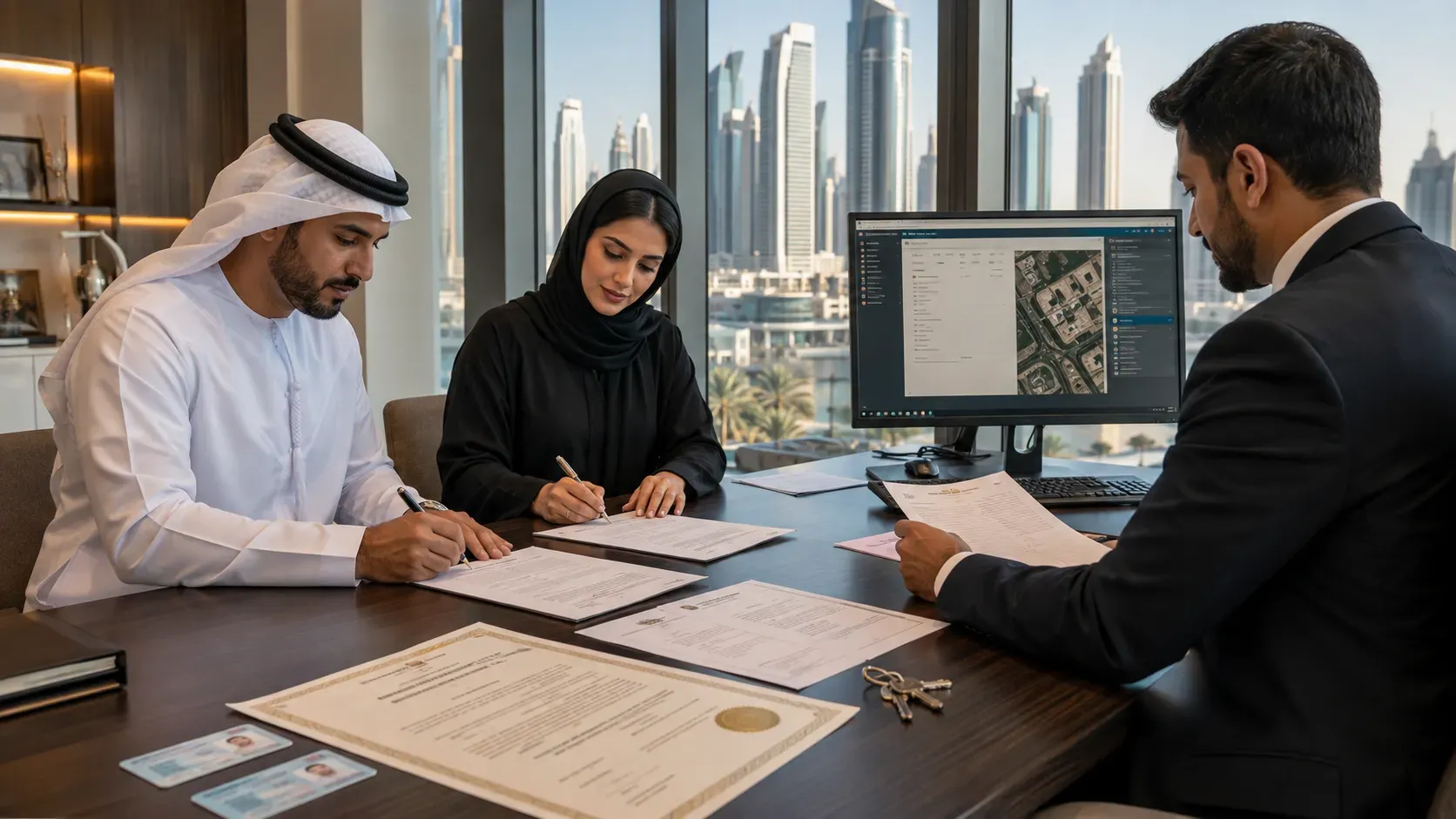
Transferring property ownership in Dubai involves more than signing a sale agreement and handing over the keys. The buyer and seller must complete the required documentation, obtain the applicable developer NOC, pay registration fees and complete the transaction through Dubai Land Department (DLD) or an authorised Real Estate Registration Trustee Centre.
DLD is the legally authorised entity for registering and documenting Dubai real estate transactions, and transactions involving ownership transfer must be registered in its records.
For a straightforward completed-property sale, the process can be relatively quick once all documents and approvals are ready. DLD currently states that its property sale registration service has a service time of around 25 minutes, while its FAQ says a sale can take an average of around 30 minutes when all required documents are available.
What Is Property Transfer in Dubai?
Property transfer is the legal process of changing the registered ownership of a property from one person or entity to another.
A typical transfer may occur when:
- A buyer purchases a completed property
- An owner sells a property
- Property ownership is transferred between eligible parties
- A property is transferred through inheritance
- Ownership is changed according to an approved legal arrangement
For a normal resale, the transfer takes place after the buyer and seller have agreed on the transaction and completed the required documentation.
The final ownership record is updated through DLD, and the buyer receives an electronic title deed once the applicable registration process is completed.
How Does Property Transfer Work in Dubai?
For a typical completed-property resale, the process generally follows these stages:
- Buyer and seller agree on the sale.
- The Sale and Purchase Agreement or applicable sale contract is prepared.
- The seller arranges the required developer NOC or e-NOC.
- The parties prepare their identification and transaction documents.
- The buyer and seller attend the applicable registration channel or complete an eligible digital process.
- DLD reviews the transaction.
- Applicable fees are paid.
- Ownership is registered in the buyer's name.
- The electronic title deed and property map are issued.
The exact procedure can change depending on whether the property is mortgaged, off-plan, inherited, company-owned or subject to other restrictions.
What Documents Are Needed for Dubai Property Transfer?
For an individual sale registration, DLD's current service lists the Emirates IDs of the seller and buyer for identification, or a valid passport for non-resident foreigners. It also lists an e-NOC from the developer in freehold areas, obtained through the Dubai REST App.
Depending on the transaction, additional documents may be required.
These can include:
- Sale and Purchase Agreement
- Title deed
- Developer NOC
- Mortgage-related documents
- Power of attorney
- Company documents
- Bank documents
- Other documents relating to the specific transaction
If someone is representing the buyer or seller, an appropriate power of attorney may also be required.
DLD's title transfer service specifically requires a letter from the transferor and UAE ID or appropriate power-of-attorney documentation, with valid passports required for non-resident owners in the applicable process.
What Is the Role of the Dubai Property NOC?
The No Objection Certificate (NOC) is an important part of many Dubai property transfers.
For freehold-area sales, DLD's current property sale registration service requires an e-NOC from the developer.
The NOC can help confirm that the developer has no objection to the proposed transfer and may involve checking matters such as outstanding service charges or property-related obligations.
DLD's investor guidance also explains that the developer NOC can confirm payment of applicable service charges and the absence of relevant violations in the circumstances covered by the guidance.
Because requirements can differ between developments, sellers should check the current NOC process with the relevant developer before arranging the final transfer.
How Does the Sale and Purchase Agreement Affect Property Transfer?
The Sale and Purchase Agreement (SPA) records the commercial terms agreed between the parties.
It can cover:
- Purchase price
- Payment schedule
- Completion arrangements
- Handover
- Buyer and seller obligations
- Default provisions
- Cancellation terms
- Other agreed conditions
For a completed-property resale, the applicable DLD sale contract is also an important part of the transaction.
The agreement should be reviewed carefully before the transfer appointment because mistakes in the property details, purchase price or agreed terms can cause unnecessary delays.
For more information, see Understanding the Sale and Purchase Agreement (SPA).
Where Does Property Transfer Take Place in Dubai?
Traditional property sales can be registered through Real Estate Registration Trustee Centres.
DLD's current property sale registration process involves submitting the required documents to the trustee centre, verification, entering the transaction details into the system, auditing, paying the applicable fees and completing the registration.
DLD also offers digital services for eligible transactions.
For example, Dubai Now allows eligible users to generate and sign an SPA, transfer the purchase amount and service fees through the specified escrow account and view the title deed and receipt.
However, the Dubai Now service has specific conditions. It applies to eligible individuals with UAE ID, freehold properties without restrictions or mortgages and certain subdivided units such as apartments, offices and townhouses.
Therefore, buyers should not assume that every property transfer can be completed digitally.
How Much Does Property Transfer Cost in Dubai?
The largest registration cost in a standard property sale is generally the DLD sale registration fee.
DLD's current property sale registration service lists:
- Seller: 2% of the sale value
- Buyer: 2% of the sale value
- AED 250 for title deed certificate issuance
- AED 225 for a unified Dubai Municipality map
- AED 250 for villa and apartment maps
- AED 10 knowledge fee
- AED 10 innovation fee
The service also lists Real Estate Registration Trustee partner fees of AED 4,000 + VAT where the sale value is AED 500,000 or more, and AED 2,000 + VAT where it is below AED 500,000.
These figures relate to the current DLD service and should be checked again when completing an actual transaction because applicable fees and procedures can change.
Other costs may also apply depending on whether the property is mortgaged, financed or subject to other arrangements.
What Happens During the Property Transfer Appointment?
Once the buyer and seller arrive at the applicable registration centre, the transaction documents are reviewed.
The process generally involves:
Document Verification
The registration team checks the required documents and identifies missing information if applicable.
Transaction Entry
The transaction details are entered into the DLD system.
Audit and Approval
The transaction is reviewed before the registration can be completed.
Fee Payment
The applicable DLD and service fees are paid.
Ownership Registration
Once the transaction is approved and completed, the property's registered ownership is updated.
Title Deed Issuance
The buyer receives the electronic title deed and applicable property map.
This is why having all documents ready before the appointment is important.
How Long Does Property Transfer Take in Dubai?
The actual registration stage can be relatively fast when the transaction is straightforward.
DLD currently lists a 25-minute service time for its property sale registration service.
DLD's FAQ similarly states that when all required documents are available, registering a sale and receiving the title deed takes an average of approximately 30 minutes.
However, this does not mean the entire property sale always takes 30 minutes.
The overall transaction can take longer because of:
- NOC processing
- Mortgage clearance
- Bank requirements
- Missing documents
- Buyer financing
- Seller obligations
- Property restrictions
- Developer approvals
- Scheduling
The registration itself may be quick, while preparing the transaction can take considerably longer.
What Happens If the Property Has a Mortgage?
A mortgaged property requires additional procedures.
The seller generally needs to address the outstanding mortgage and obtain the appropriate bank documentation before the ownership transfer can be completed.
DLD provides a separate service for registering the sale of a mortgaged property, indicating that these transactions have additional requirements compared with a straightforward unencumbered sale.
Buyers purchasing a mortgaged property should therefore coordinate closely with:
- Seller
- Seller's bank
- Buyer's bank
- Developer where applicable
- Real Estate Registration Trustee
- DLD
The exact procedure depends on how the existing mortgage and new financing are structured.
How Does Property Transfer Work for Off-Plan Properties?
Off-plan property follows a different registration process from a completed resale.
DLD uses initial registration for certain off-plan transactions before the property is transferred into the real estate registry.
For initial sale registration, DLD currently states that the sale and purchase contract must be signed by the developer and purchaser and registered in the provisional register within 90 days from the date of signing the contract.
The buyer may receive a provisional registration certificate rather than the final title deed at this stage.
Once the project is completed and the applicable conditions are met, fully paid units can be transferred from the initial register to the Real Estate Registry and the title deed can be issued.
What Happens After Property Transfer?
After the transfer is successfully completed, the buyer becomes the registered owner according to the updated DLD record.
The buyer should:
- Download and save the electronic title deed
- Keep the property map
- Keep payment receipts
- Confirm parking details
- Arrange utilities
- Update relevant building records
- Collect keys if applicable
- Complete post-handover requirements
If the property is intended for rental, the owner can then proceed with the appropriate leasing and tenancy registration procedures.
The title deed should be stored securely because it is an important ownership document.
Dubai Property Transfer Checklist
Step | What to Check |
|---|---|
Sale agreement | Terms and property details |
Title deed | Seller's ownership details |
NOC | Developer approval where required |
Service charges | Outstanding amounts cleared |
Mortgage | Existing financing addressed |
IDs | Buyer and seller documents ready |
POA | Valid if representatives are involved |
DLD fees | Current fees confirmed |
Transfer appointment | Correct date and location |
Payment | Required amounts prepared |
Registration | Transaction approved |
Title deed | Electronic copy received |
Property map | Copy received and stored |
Frequently Asked Questions About Property Transfer in Dubai
How does property transfer work in Dubai?
The buyer and seller agree on the sale, prepare the required documents, obtain the applicable NOC, complete DLD registration, pay the required fees and receive the updated electronic title deed.
How much is the property transfer fee in Dubai?
DLD's current property sale registration service lists a 2% fee for the seller and 2% for the buyer, calculated on the sale value, in addition to applicable title deed, map and service fees.
How long does property transfer take in Dubai?
DLD currently lists a service time of around 25 minutes for property sale registration. Its FAQ states that a straightforward sale can take around 30 minutes when all required documents are available.
Is an NOC required for property transfer in Dubai?
For freehold-area sales, DLD currently lists an e-NOC from the developer as a required document.
Do I receive a title deed after property transfer?
Yes. Once the applicable sale registration process is completed, DLD issues an electronic title deed and property map.
Can property transfer be completed online?
Some eligible transactions can be completed digitally through Dubai Now, but the service has specific eligibility conditions, including requirements relating to UAE ID, freehold property, absence of mortgages or restrictions and eligible property types.
Can foreigners transfer property ownership in Dubai?
Foreign buyers can own and transfer property in Dubai in areas where ownership is permitted under the applicable regulations. DLD's services also provide for non-resident foreigners using valid passports for identification in applicable transactions.
Final Thoughts
Property transfer in Dubai is the formal process that changes the registered ownership of a property from the seller to the buyer. While the final registration can be completed relatively quickly when everything is prepared, the buyer and seller should complete the necessary checks beforehand.
The most important steps are confirming the sale agreement, checking the title and property details, obtaining the required developer NOC, resolving mortgage or service-charge issues, preparing the necessary identification and paying the applicable DLD fees.
DLD's current property sale registration service provides a clear framework for completed-property sales, while digital options such as Dubai Now can simplify eligible transactions.
For buyers, the key is not to focus only on the final transfer appointment. Good preparation before that appointment can prevent many of the delays that make a property transaction more complicated.
If you are researching properties before making a purchase, Buy Home Dubai can be a useful starting point for exploring Dubai properties and understanding the wider buying process.

Dubai Real Estate
Ready to find your
dream home in Dubai?
Browse thousands of properties across Dubai's most sought-after neighbourhoods. Our experts are ready to guide you.