Real EstateAugust 29, 2026
How Many Properties Should You Own in Dubai?
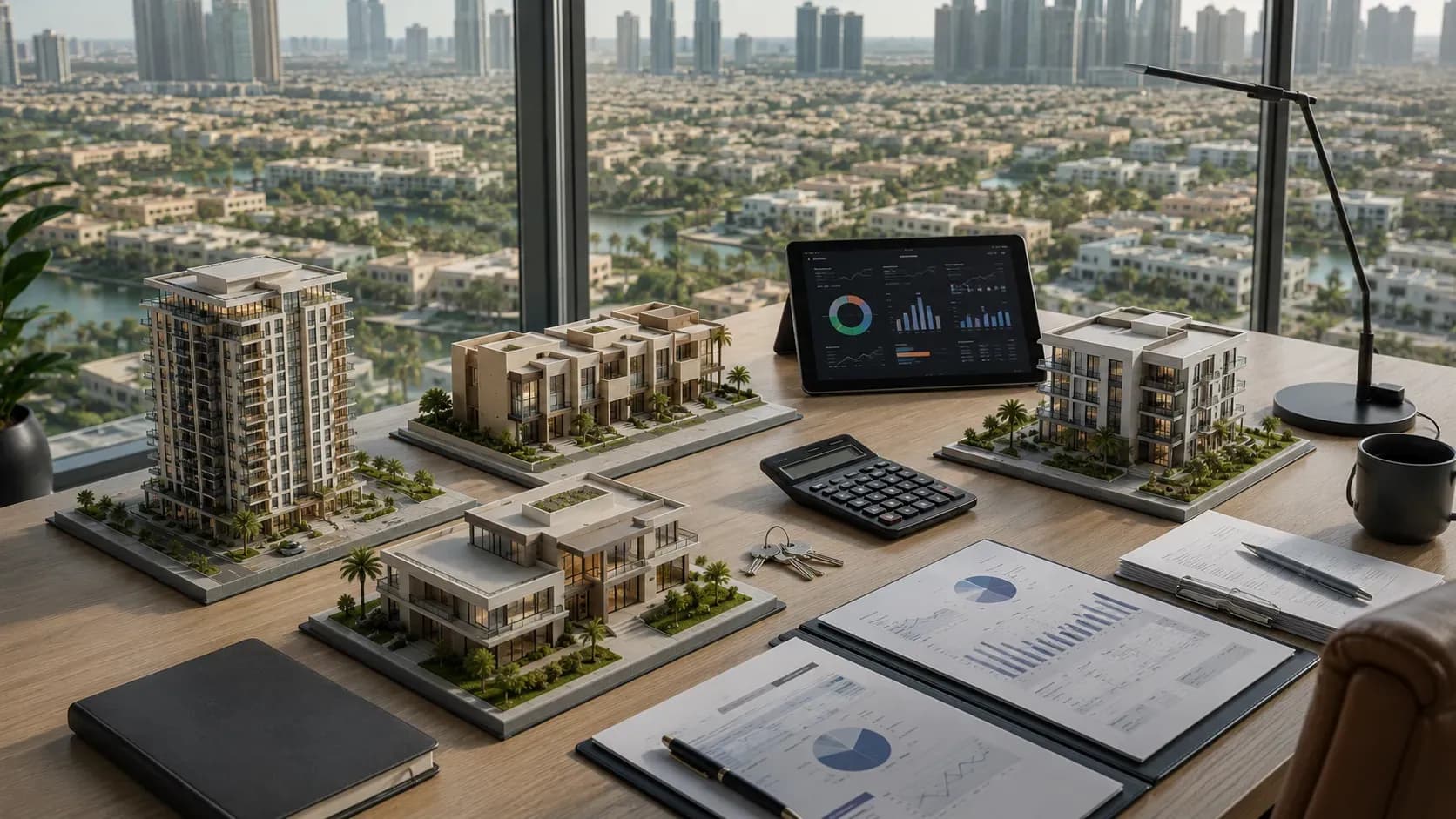
There is no universal number of properties that every investor should own in Dubai.
For one investor, owning one well-performing property may be the right strategy. Another investor may comfortably manage five, ten or more properties. The important question is not simply how many properties you can buy, but how many you can finance, manage and hold without taking excessive financial risk.
Dubai remains an active real estate market. However, strong transaction activity does not mean investors should accumulate properties without a clear strategy. Building a portfolio requires consideration of rental income, financing, liquidity, diversification, property expenses and long-term goals.
Mortgage rules also influence how quickly investors can expand. The UAE Central Bank's mortgage regulations place loan-to-value limits on property financing, with different treatment depending on factors such as whether the property is a first home, subsequent investment property or off-plan property.
The right number of properties is therefore personal. Your income, available capital, existing debt, cash reserves and investment objectives should determine the size of your portfolio.
Is There an Ideal Number of Properties to Own?
There is no fixed ideal number.
A common mistake is assuming that owning more properties automatically means building a better portfolio.
It does not.
For example, an investor might own:
- One property generating strong net rental income
- Three properties with weak cash flow
- Five highly leveraged properties
- Ten properties concentrated in the same neighbourhood
The investor with one well-performing property may have a healthier portfolio than the investor with ten highly leveraged properties.
The objective should be to build quality and resilience, rather than simply increasing the property count.
Your ideal portfolio size should allow you to:
- Meet mortgage obligations comfortably
- Cover property expenses
- Handle vacancies
- Maintain emergency reserves
- Manage tenants and properties
- Diversify your investments
- Take advantage of future opportunities
If adding another property makes your finances significantly more fragile, it may be better to wait.
How Many Properties Can You Afford in Dubai?
Affordability should be assessed using your overall financial position, not just your available down payment.
Consider your:
- Monthly income
- Existing mortgages
- Other debts
- Available savings
- Expected rental income
- Property expenses
- Transaction costs
- Emergency fund
- Future financial commitments
Suppose you have enough savings for another down payment. That does not necessarily mean you should immediately buy another property.
You also need to consider the cash required for:
- Purchase-related fees
- Mortgage costs
- Service charges
- Maintenance
- Furnishing
- Vacancy periods
- Property management
- Unexpected repairs
An investor who uses nearly all available cash to acquire another property may have limited flexibility if circumstances change.
A more conservative approach is to maintain sufficient liquidity after each purchase.
How Income and Cash Flow Affect Your Property Portfolio
Rental income can help support a growing property portfolio, but investors should not assume that rent equals profit.
For each property, calculate the difference between rental income and total expenses.
Potential expenses include:
- Mortgage payments
- Service charges
- Maintenance
- Property management
- Insurance
- Vacancy
- Repairs
- Utilities where applicable
- Other operating costs
A property advertised with a high rental yield may produce a much lower net return after expenses.
For example, imagine a property generating AED 70,000 in annual rent.
If annual operating expenses and other costs reduce the effective income to AED 50,000, the investor should evaluate the property based on the lower figure rather than the headline rent.
This becomes even more important when you own multiple properties.
A small cash-flow problem in one property may be manageable.
The same problem across five properties can become significant.
How Mortgage Financing Limits the Number of Properties You Should Own
Financing can help investors expand their portfolios, but borrowing also introduces additional risk.
The UAE Central Bank regulates mortgage lending and establishes loan-to-value limits for different property situations. The applicable limits can vary depending on factors such as whether the property is a first home, subsequent property or an off-plan purchase.
For investment properties, banks also consider the borrower's overall financial position and debt obligations.
This means an investor should not calculate affordability based only on:
"How much can I borrow?"
A better question is:
"How much can I borrow while still maintaining a comfortable financial buffer?"
Before taking another mortgage, calculate the impact of the additional debt on your monthly cash flow.
Consider what would happen if:
- The property remains vacant for several months
- Rental income decreases
- Maintenance costs increase
- Your personal income changes
- Financing costs increase
- Another property requires an unexpected repair
A portfolio should be able to withstand temporary setbacks.
Should You Own Multiple Properties in the Same Dubai Area?
Owning multiple properties in the same area can be convenient, but it creates concentration risk.
Suppose an investor owns four apartments in one community.
If rental demand in that area weakens, all four properties could be affected simultaneously.
The same applies to:
- Oversupply
- Major construction activity
- Changes in tenant preferences
- Service-charge increases
- Local infrastructure problems
- Falling resale demand
Concentration is not automatically bad.
An investor may deliberately specialise in one area because they understand its rental market particularly well.
However, you should recognise the risk before expanding.
Ask whether your next property adds diversification or simply increases your exposure to an existing market.
How to Diversify a Dubai Property Portfolio
Diversification can be achieved in several ways.
Diversify by Location
You could own properties in different Dubai communities that attract different tenant groups.
Diversify by Property Type
A portfolio could contain:
- Apartments
- Townhouses
- Villas
- Premium residences
Diversify by Tenant Profile
Different properties may appeal to:
- Young professionals
- Families
- Executives
- Students
- Long-term residents
Diversify by Investment Objective
One property could focus on rental income while another targets long-term capital growth.
However, diversification should remain practical.
Owning ten different properties across ten different areas can create significant management complexity.
The objective is not maximum diversification.
It is appropriate diversification.
When Should You Buy Your Second Property in Dubai?
There is no requirement to buy a second property immediately after purchasing your first.
In many cases, waiting can be beneficial.
Before buying your second property, review how the first one has actually performed.
Ask:
- Is it generating the expected rent?
- What is the actual net yield?
- Are service charges higher than expected?
- How long did it take to find a tenant?
- Are maintenance costs manageable?
- Has the property appreciated?
- How much cash reserve remains?
- Can you comfortably handle another mortgage?
If the first property is performing well and you have sufficient capital and reserves, a second acquisition may make sense.
If the first property is creating financial pressure, adding another property may make the situation worse.
When Should You Stop Adding Properties to Your Portfolio?
There is no specific property count at which every investor should stop.
Instead, consider whether the next acquisition would improve your financial position.
You may want to slow down when:
Your Debt Is Becoming Too High
Additional borrowing may create unnecessary financial pressure.
Your Cash Reserves Are Too Low
A portfolio without adequate liquidity can become vulnerable to unexpected expenses.
Properties Are Underperforming
If several properties are producing weaker-than-expected returns, buying more may not solve the problem.
Management Is Becoming Difficult
More properties mean more tenants, maintenance issues, paperwork and financial tracking.
Your Portfolio Is Too Concentrated
If most properties are exposed to the same location or tenant segment, another similar property may increase risk.
Your Investment Goals Have Changed
You may eventually want to allocate money to other investments instead of acquiring additional real estate.
How Many Rental Properties Do You Need to Generate Passive Income?
There is no fixed number.
The number depends on your target monthly income and the net cash flow from each property.
For example, if your goal is AED 10,000 in monthly net rental income and each property generates AED 2,500 in net income, you would theoretically need four similar properties.
But real portfolios rarely work so neatly.
Rental income can vary significantly between properties.
You also need to account for:
- Vacancies
- Repairs
- Service charges
- Management costs
- Financing
- Changes in rental rates
Therefore, calculating your target based on net income rather than gross rent provides a more realistic picture.
Read Passive Income Through Dubai Property for a broader look at property-generated income.
What Are the Risks of Owning Too Many Properties?
Owning too many properties can create several problems.
Financial Risk
More mortgages mean greater monthly obligations.
Vacancy Risk
Multiple vacant properties can significantly reduce rental income.
Maintenance Risk
A major repair across several properties can create a substantial expense.
Management Risk
Managing tenants, contractors and documentation becomes more complicated as the portfolio grows.
Market Risk
A portfolio concentrated in one property type or location can be affected by changes in that segment.
Liquidity Risk
Property is not as easily converted into cash as many financial assets.
Selling a property can take time and involves transaction costs.
Opportunity Cost
Capital tied up in additional properties cannot be used elsewhere.
This is why a larger portfolio is not necessarily a safer or more profitable portfolio.
How to Decide the Right Number of Properties for Your Portfolio
A practical way to determine your ideal portfolio size is to work through five stages.
1. Define Your Goal
Decide whether you want:
- Rental income
- Capital growth
- Long-term wealth accumulation
- Retirement income
- Portfolio diversification
2. Calculate Your Available Capital
Determine how much you can invest without exhausting your savings.
3. Calculate Your Maximum Comfortable Debt
Do not simply use the maximum amount a lender is willing to offer.
Calculate the amount you can comfortably service under less favourable conditions.
4. Analyse Existing Properties
Calculate the actual performance of your current portfolio.
5. Identify What the Next Property Adds
The next property should ideally provide something your current portfolio lacks.
That could be:
- Higher rental income
- Different tenant demand
- Geographic diversification
- A different property type
- Long-term growth potential
If it adds nothing except another mortgage, reconsider the purchase.
Common Mistakes When Building a Dubai Property Portfolio
Buying More Properties Just Because You Can
Financing capacity is not the same as financial affordability.
Ignoring Net Returns
Always account for expenses before judging a property's performance.
Overusing Mortgage Financing
High leverage can amplify both gains and losses.
Keeping All Properties in One Area
This can create concentration risk.
Buying Similar Properties Without a Strategy
Four properties that serve exactly the same purpose may provide less diversification than expected.
Ignoring Liquidity
Do not invest every available dirham into property.
Failing to Review Existing Investments
Your portfolio should be evaluated regularly.
Treating Rental Income as Guaranteed
Vacancies and changing market conditions can affect actual income.
Expanding Too Quickly
Buying several properties in a short period can make financial and operational problems harder to identify.
Dubai Property Portfolio Checklist
Before buying another property, ask yourself:
Question | Why It Matters |
|---|---|
What is my investment goal? | Defines the property's purpose |
Can I comfortably afford it? | Controls financial risk |
How much debt will I take? | Determines leverage |
What is the expected net rental income? | Measures cash flow |
How much cash will remain afterward? | Protects liquidity |
Is my portfolio already concentrated? | Identifies diversification risk |
Does this property add something new? | Improves portfolio structure |
Can I manage another property? | Controls operational complexity |
What happens if it stays vacant? | Tests downside risk |
What is my exit strategy? | Supports long-term planning |
Frequently Asked Questions
How many properties should I own in Dubai?
There is no universal number. The appropriate number depends on your income, capital, financing, cash flow, risk tolerance and investment objectives.
Is owning multiple properties in Dubai a good investment strategy?
It can be, provided the properties are financially viable and the portfolio is appropriately diversified. Buying multiple properties without considering debt and cash flow can increase risk.
Should I buy a second property after buying my first?
Only if your first investment is performing reasonably well and you have enough capital, reserves and financing capacity to take on another property.
How many rental properties do I need to replace my income?
It depends on the net income generated by each property and the income you want to replace. Calculate using net rental cash flow rather than gross rent.
Is it better to own one expensive property or several smaller properties?
Neither is automatically better. Several properties can provide diversification, while one premium property may offer different rental and capital-growth characteristics. Compare the actual risk and return of each strategy.
Can I finance multiple properties in Dubai?
Financing multiple properties may be possible, but applicable mortgage rules, loan-to-value limits, income requirements and bank policies must be considered. The UAE Central Bank's regulations distinguish between different property and borrower situations.
Should all my Dubai properties be in the same area?
Not necessarily. Concentrating properties in one location can increase exposure to local market conditions. Diversification can reduce this concentration, although managing multiple locations can also be more complex.
When should I stop buying more properties?
Consider slowing down when additional debt becomes uncomfortable, cash reserves become too low, existing properties underperform or your portfolio becomes overly concentrated.
Final Thoughts
There is no magic number of properties that every Dubai investor should own.
For some investors, one carefully selected property may be enough. Others may gradually build a portfolio of several properties over many years.
The most important consideration is whether each additional property improves your overall financial position.
Before buying another property, review your cash flow, debt, reserves, rental performance, diversification and long-term objectives. If the next property adds useful income or diversification without putting excessive pressure on your finances, it may be worth considering.
If buying another property simply means taking on more debt and increasing concentration risk, waiting may be the better decision.
Dubai's property market offers investors many opportunities, but a successful portfolio is not measured by the number of properties on a spreadsheet. It is measured by how well those properties work together.
For more Dubai property investment guides, buying advice and real estate insights, visit Buy Home Dubai.

Dubai Real Estate
Ready to find your
dream home in Dubai?
Browse thousands of properties across Dubai's most sought-after neighbourhoods. Our experts are ready to guide you.