Real EstateOctober 15, 2026
Dubai vs Abu Dhabi Property Investment: Which Emirate Wins?
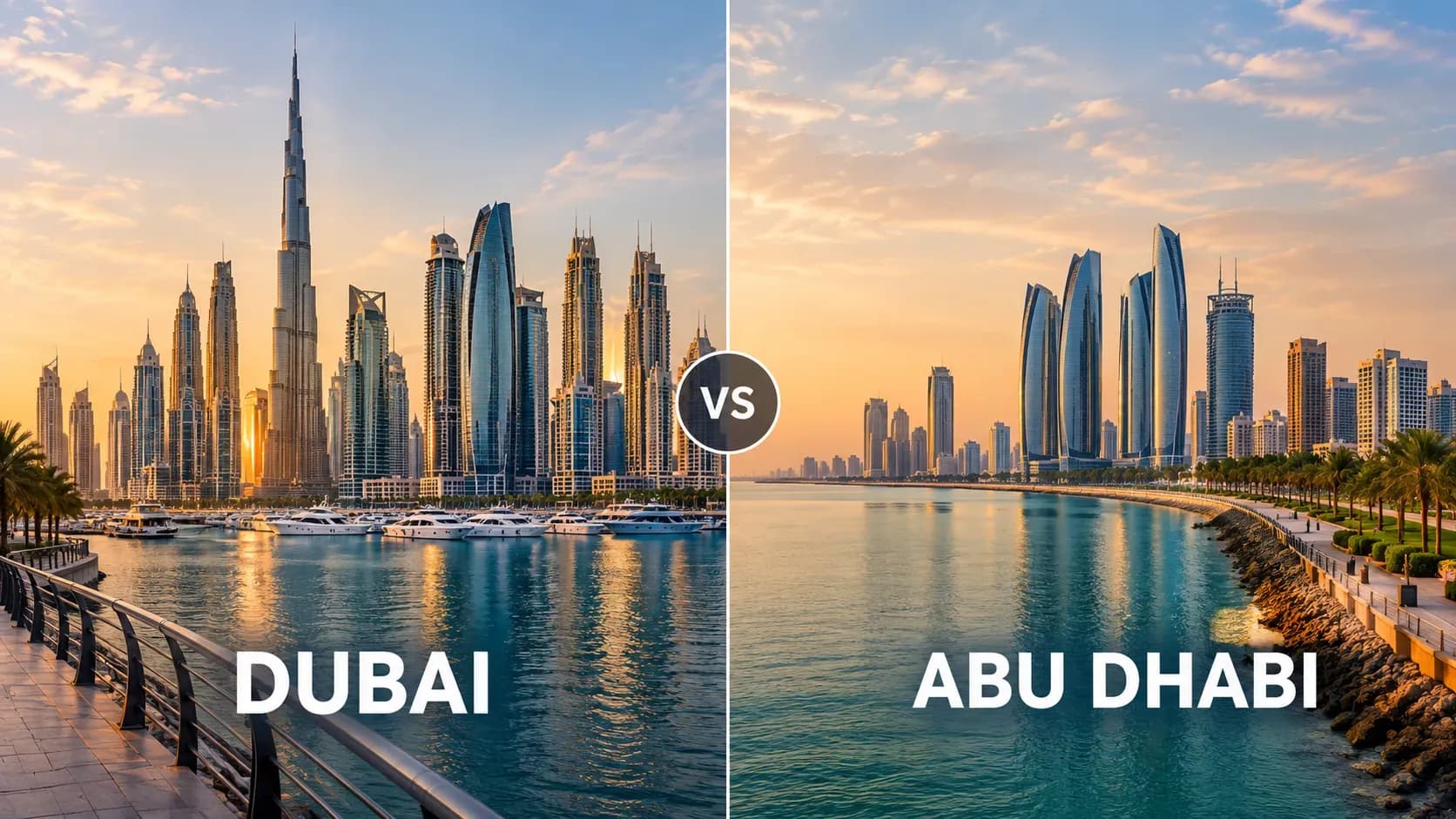
Two headlines, side by side. In one, Abu Dhabi property sales have more than doubled. In the other, Dubai prices have barely moved. If you're about to put serious money into UAE property, which one do you follow?
The honest answer depends on what you want from the investment. This guide compares Dubai vs Abu Dhabi property investment on prices, yields, fees, who can buy and the risks, so you can match the emirate to your goal.
Quick Answer
Dubai offers deeper liquidity, a larger rental market and a longer track record. Abu Dhabi has grown faster recently and charges a lower transfer fee, about 2% against Dubai's 4%, but it is a smaller market in the middle of a surge. Choose Dubai for depth and Abu Dhabi for growth potential, then match it to your goal.
Key Takeaways
- Dubai is the bigger, more liquid market. It recorded about 79,300 sales in H1 2026, nearly five times Abu Dhabi's 16,585.
- Abu Dhabi is growing faster. Reported apartment prices rose about 22.5% year on year, while Dubai's average rose about 1.9%.
- Yields are close. Dubai apartments average about 6.9% gross; Abu Dhabi apartments commonly run 6% to 8% in Reem and Yas.
- Abu Dhabi costs less to buy. The transfer fee is about 2%, against 4% in Dubai.
- Both are heavily off-plan. Around three quarters of recent sales in each emirate were off-plan, so delivery risk matters in both.
Dubai vs Abu Dhabi Property Investment at a Glance
Here is the side-by-side picture, using 2026 market reports.
Dubai | Abu Dhabi | |
|---|---|---|
H1 2026 sales | About 79,300 deals, AED 221.4 billion | About 16,585 deals, AED 84.49 billion |
Off-plan share of sales | About 75% | About 78% |
Price trend | Average about AED 1,639 per sqft, up about 1.9% year on year | Apartments about AED 1,927 per sqft (up 22.5%), villas about AED 1,500 (up 41%) |
Gross yield | About 6.9% apartments, 5.0% villas | About 6% to 8% apartments in Reem and Yas, villas about 5% |
Transfer fee | 4% | About 2% |
Foreign ownership | Freehold in designated areas | Freehold in designated investment areas |
Supply ahead | About 162,500 units scheduled for 2027 | About 71,000 new homes by 2030 |
Market feel | Mature and consolidating | Younger and surging |
These figures come from different reports with different methods, so use them as a guide to direction, not a precise like-for-like scorecard.
Market Size and Liquidity
Dubai is the larger market by a wide margin. Cavendish Maxwell recorded about 79,300 sales worth AED 221.4 billion in the first half of 2026, according to Khaleej Times' report on Dubai's H1 2026 market.
Abu Dhabi's market is smaller but moving quickly. ADXinteract data showed 16,585 deals worth AED 84.49 billion in H1 2026, up 103% in volume.
Why does size matter to you?
- Easier exits. More buyers and agents mean a resale is easier to line up.
- Better price evidence. More sales give you more comparable prices.
- Deeper rental demand. Dubai's population is above 4.0 million, against roughly 2.5 million in Abu Dhabi's urban area.
A smaller market isn't a worse one. It simply means fewer buyers when you want to sell.
Prices and Capital Growth
This is where the two emirates look most different.
Dubai is consolidating. The average sales price was about AED 1,639 per sqft in June 2026, up around 1.9% year on year, and developers have launched far fewer projects than in 2025. Our guide to the Dubai property market in 2026 covers that story in more depth.
Abu Dhabi is surging:
- Median apartment prices were about AED 1,927 per sqft, up 22.5% year on year
- Median villa prices were about AED 1,500 per sqft, up 41%
- ValuStrat's freehold index rose 17.8% year on year in Q1 2026
Fast growth is attractive, but it isn't a guarantee. A recent surge can cool just as quickly, and rapid rises mean you are paying today's price for tomorrow's hoped-for gains.
A word on comparing prices. Dubai's figure above is an all-types average from one report, and Abu Dhabi's are medians by type from another. Asking-price data from Engel & Völkers puts apartments in the two emirates almost level, at around AED 1,944 and AED 1,924 per sqft. So don't assume one emirate is cheaper per sqft.
Rental Yields: Where Do You Earn More?
Yields are closer than the growth gap suggests.
Property type | Dubai (gross) | Abu Dhabi (gross) |
|---|---|---|
Apartments | About 6.9% | About 6% to 8% in Reem and Yas |
Villas | About 5.0% | About 5% |
In practice:
- Apartments can work well in both emirates, with Abu Dhabi's best districts offering a slightly wider range.
- Villas yield less in both, so they suit capital growth or personal use more than income.
- Rents are rising in both. Dubai's average rent was up about 7.8% year on year, and Abu Dhabi's rent index rose about 5.9% in Q1 2026.
Gross yield is not what you keep. Service charges, management fees and vacancy reduce it, so compare net yields on the specific building before you decide.
Buying Costs and Fees
Abu Dhabi is cheaper to buy into on government fees.
Cost | Dubai | Abu Dhabi |
|---|---|---|
Transfer or registration fee | 4% | About 2% |
Agent commission | About 2% | About 2% |
Here is what that means on a AED 1.5 million purchase:
- Dubai transfer fee: AED 60,000
- Abu Dhabi transfer fee: AED 30,000
- Difference: AED 30,000 saved in Abu Dhabi
That saving is real, but it is a one-off cost. It shouldn't outweigh a weak location or a poor-quality project.
Dubai also has trustee office fees and other charges, which we explain in our guide to the Dubai Land Department fees you'll pay. Abu Dhabi has its own registration charges, so confirm the full list with an agent or the municipality.
Where Can Foreigners Buy?
In both emirates, foreigners can buy freehold property, but only in designated areas.
Dubai allows foreign freehold ownership in areas designated by the government, such as Dubai Marina, Downtown and Palm Jumeirah.
Abu Dhabi opened freehold ownership to foreigners under Law No. 13 of 2019, in specific investment areas. Reported examples include:
- Al Reem Island
- Yas Island
- Saadiyat Island
- Al Reef
- Al Raha Beach
- Masdar City
The list of areas has changed over time. Confirm the current areas with the Abu Dhabi Real Estate Centre before you commit.
If you're leaning towards Dubai, our guide to the best freehold areas in Dubai for foreign buyers shows where you can own outright.
Supply and Risk
Both markets are adding homes, and both depend heavily on off-plan sales.
Dubai | Abu Dhabi | |
|---|---|---|
Scheduled supply | About 47,000 units in H2 2026, 162,500 in 2027, 128,200 in 2028 | About 71,000 new homes by 2030, peaking near 21,800 in 2028 |
Existing stock | Large and mature | About 409,000 units |
Off-plan share | About 75% of sales | About 78% of sales |
What this means for you:
- Delivery risk. Scheduled figures are targets, and projects can slip.
- Supply waves. A big delivery year can soften rents in the districts where the supply lands.
- Concentration. Most new Abu Dhabi supply sits in six districts, including Saadiyat, Reem, Yas and Hudayriyat.
- Regional uncertainty. Market reports on both emirates mention it as a factor to watch, though ValuStrat found no clear evidence of material impact in Abu Dhabi so far.
You can read the full pipeline in Gulf News' coverage of Abu Dhabi's housing supply forecast.
Dubai vs Abu Dhabi Property Investment: Which Suits Your Goal?
Match the emirate to what you want.
Your goal | Better fit | Why |
|---|---|---|
Easy resale and liquidity | Dubai | Much larger market and more buyers |
Capital growth | Abu Dhabi, with caution | Faster recent growth, but a recent surge can cool |
Rental income | Either | Apartment yields are similar; check net yield |
Lower upfront costs | Abu Dhabi | Transfer fee is about half |
First UAE purchase from abroad | Dubai | More agents, listings and resale data to lean on |
Diversifying across the UAE | Both | Different cycles and different districts |
Many investors don't choose one. They hold Dubai for depth and add Abu Dhabi for growth, or the other way round.
Mistakes to Avoid When Comparing the Two
- Chasing the headline growth number. A 22% rise tells you where prices went, not where they are going.
- Ignoring the off-plan share. A booming sales figure can be mostly paper commitments, not finished homes.
- Forgetting exit costs. Lower buying fees don't help if the resale market is thin.
- Assuming the rules match. Ownership areas, fees and registration steps differ between the emirates.
- Comparing prices from different sources. Check whether figures are averages, medians or asking prices.
Frequently Asked Questions
Is Abu Dhabi or Dubai better for property investment?
Neither wins on every measure. Dubai offers deeper liquidity and a larger rental market. Abu Dhabi has grown faster recently and costs less to buy. Pick based on whether you value resale ease or growth potential.
Are rental yields higher in Dubai or Abu Dhabi?
They are close. Dubai apartments average about 6.9% gross, while Abu Dhabi apartments commonly run 6% to 8% in areas like Reem and Yas. Villas yield about 5% in both. Compare net yields building by building.
Is it cheaper to buy property in Abu Dhabi than Dubai?
On government fees, yes. Abu Dhabi's transfer fee is about 2%, against Dubai's 4%. On price per square foot, the picture depends on the source and property type, so compare like with like.
Can foreigners buy property in Abu Dhabi?
Yes, in designated freehold investment areas under Abu Dhabi's 2019 ownership law. Examples include Al Reem, Yas and Saadiyat. Confirm the current list of areas with the Abu Dhabi Real Estate Centre before buying.
Which emirate has better capital growth?
Abu Dhabi has shown faster recent growth, with reported apartment prices up about 22.5% year on year, against about 1.9% in Dubai. Past growth isn't a promise, and fast surges can cool.
Pick the Emirate That Fits Your Plan
Dubai vs Abu Dhabi property investment isn't a contest with one winner. Dubai gives you depth, choice and an easier exit. Abu Dhabi gives you lower fees and strong recent momentum, with the risk that comes from a younger surge.
Decide what you need first, whether that is income, growth or flexibility, then compare the specific building, not just the emirate. Helping you make that choice with clear numbers is exactly what BuyHomeDubai is here for.

Dubai Real Estate
Ready to find your
dream home in Dubai?
Browse thousands of properties across Dubai's most sought-after neighbourhoods. Our experts are ready to guide you.