Real EstateAugust 21, 2026
When Is the Best Time of Year to Buy Property in Dubai?
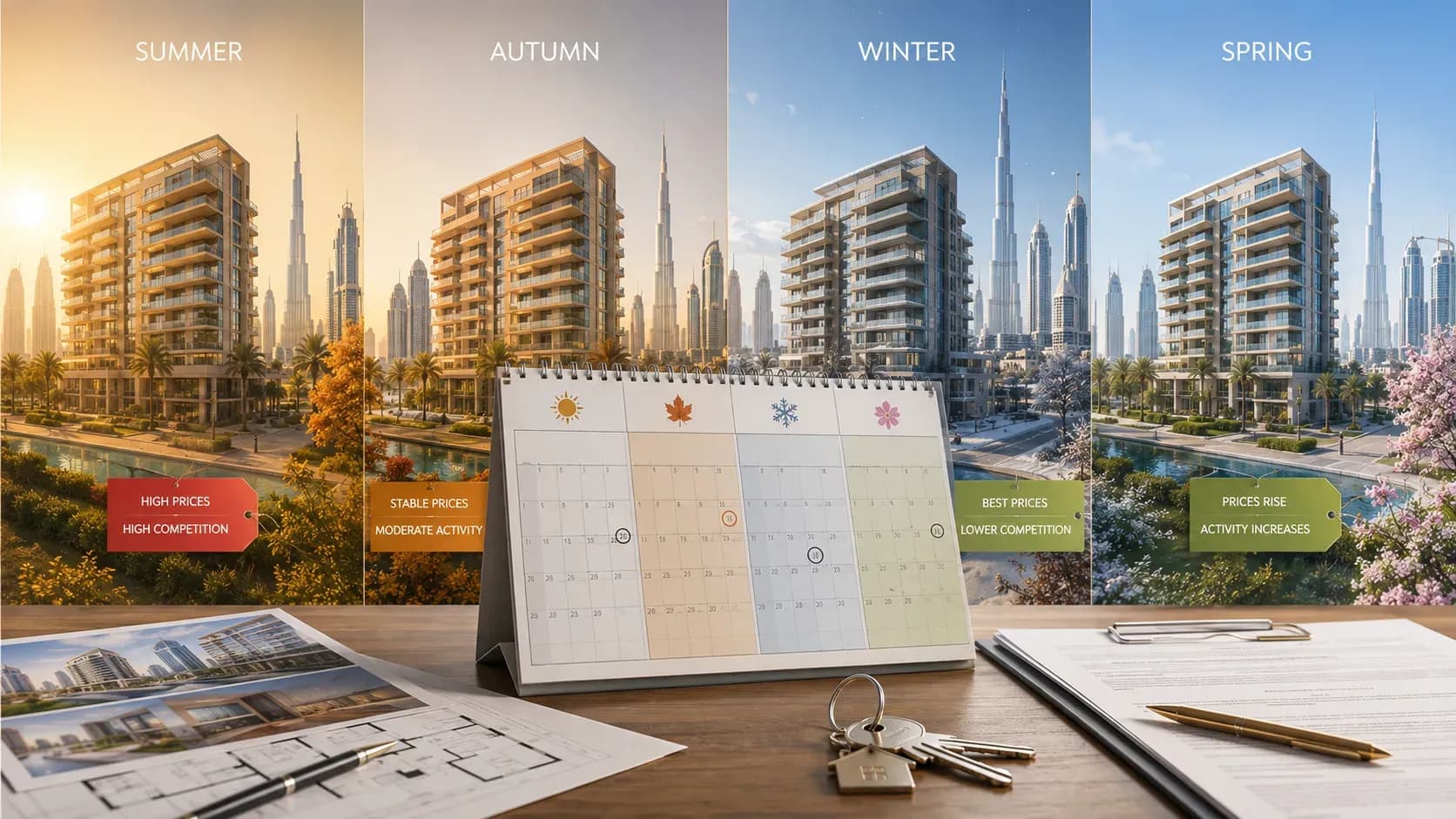
There is no single month that is guaranteed to be the cheapest or best time to buy property in Dubai.
The better question is when the right combination of price, property choice, seller flexibility and your own financial readiness comes together.
Dubai's property market remains active throughout the year, but buyer activity, available inventory and seller behaviour can change with the seasons. Summer can sometimes provide more room for negotiation, while the cooler months can bring stronger buyer activity and more competition. However, these patterns do not mean every property follows the same cycle.
Dubai Land Department reported AED 252 billion in real estate transactions in Q1 2026, representing a 31% year-on-year increase in transaction value. This continued activity means buyers should not rely on a simple "wait until summer for cheaper prices" strategy.
Instead, buyers should consider seasonal patterns alongside property-specific factors, market conditions and personal finances.
When Is the Best Time of Year to Buy Property in Dubai?
For many buyers, the best time to buy is when a suitable property is available at a price that makes sense based on comparable market evidence.
There are periods when competition may be higher or lower, but there is no guaranteed annual discount season.
A buyer looking for a good opportunity should consider:
- Current property prices
- Comparable transactions
- Available inventory
- Seller motivation
- Property condition
- Financing costs
- Developer payment plans
- Expected rental demand
- Long-term investment objectives
The season should be one factor in your decision, not the entire strategy.
For example, waiting several months for a potential seasonal discount may not make sense if you have already found a well-priced property in a strong location.
Is There a Best Month to Buy Property in Dubai?
Not necessarily.
Dubai's property market does not follow a predictable cycle where one particular month always produces the lowest prices.
Property Finder's current market guidance states that there is no specific season that is universally favourable for buying property in Dubai. It also highlights that different communities can behave differently, meaning the market should not be treated as one uniform market.
This is important because a popular apartment building may have strong demand even during a traditionally quieter month.
At the same time, an owner who has struggled to sell a property may become more flexible regardless of the season.
Therefore, instead of asking:
"Which month has the cheapest property?"
Ask:
"Which properties are attractively priced right now, and which sellers have a reason to negotiate?"
Is Summer the Best Time to Buy Property in Dubai?
Summer can create opportunities for buyers, but it is not automatically the cheapest season.
Dubai's summer months can see changes in viewing activity because of high temperatures, travel patterns and seasonal behaviour.
Property Finder's UAE market analysis identifies May to September as a period that can sometimes experience lower competition, while activity generally strengthens from October through April.
This can potentially benefit buyers in several ways.
Less Competition
If fewer buyers are actively viewing properties, you may face less competition for certain units.
More Seller Flexibility
Some sellers may be more willing to negotiate when they have received fewer serious offers.
Easier Negotiations
Lower competition can give a buyer more time to evaluate the property instead of making a quick decision because several other buyers are interested.
However, there is an important limitation.
Lower activity does not automatically mean lower prices.
A high-quality property in a desirable location can remain expensive throughout the year.
Should You Buy Property in Dubai During Ramadan?
Ramadan should not automatically be treated as a period when Dubai property prices become cheaper.
Property activity can change during Ramadan because of altered working hours, viewing schedules and buyer behaviour.
However, Property Finder's analysis of historical Ramadan data found that the effect of Ramadan itself was smaller than broader seasonal factors such as summer and holiday periods.
Therefore, buyers should not delay a good purchase simply because they expect Ramadan to produce automatic discounts.
Instead, examine the individual property.
If a seller is motivated and the property is already attractively priced, Ramadan may simply be when you happen to find the right opportunity.
Is Winter a Better Time to Buy Property in Dubai?
Dubai's cooler months typically bring stronger outdoor activity and greater interest in the city.
This can also contribute to increased property searches and viewings.
For buyers, the advantage of this period can be greater choice and easier property evaluation, particularly when viewing communities, amenities and outdoor spaces.
However, stronger buyer activity can also create more competition.
A property that attracts several interested buyers may become harder to negotiate.
This creates an important trade-off:
More market activity can mean more choice, but it can also mean more competition.
If you find a property you genuinely want during a busy period, waiting purely for a quieter season could mean losing it.
How Do Dubai Property Market Cycles Affect the Best Time to Buy?
Seasonality is only one part of property-market timing.
The broader market cycle can have a much greater impact.
Consider:
- Property prices
- Transaction volumes
- New project launches
- Available inventory
- Mortgage rates
- Rental demand
- Population growth
- Economic conditions
- Investor activity
Dubai's market has remained active in 2026.
DLD reported AED 252 billion in real estate transactions during Q1 2026, with transaction value increasing 31% year over year and transaction volume increasing 6%.
This illustrates why buyers should be cautious about trying to "time the bottom" based solely on seasonal patterns.
A seasonal slowdown does not necessarily mean prices will fall substantially.
When Are Dubai Property Sellers More Likely to Negotiate?
Seller motivation is often more important than the calendar.
A seller may be more flexible when:
The Property Has Been Listed for a Long Time
A property that has remained on the market for an extended period may have an asking price that is not attracting sufficient buyers.
The Seller Needs a Faster Transaction
A seller who needs to relocate or complete another purchase may value certainty and speed.
The Property Needs Repairs
If a property requires significant work, the buyer may be able to negotiate based on realistic repair costs.
Similar Properties Are Cheaper
If comparable units are available for less, the seller may need to adjust expectations.
The Property Has Limited Demand
A unit with an undesirable layout, poor view, high service costs or other limitations may have a smaller buyer pool.
However, do not assume that every seller who has listed a property for a long time is desperate to sell.
Some owners are willing to wait for their preferred price.
How Does Supply and Demand Affect the Best Time to Buy?
Supply and demand can have a greater influence on negotiation than the season.
When demand is strong and suitable properties are limited, sellers may have less incentive to reduce prices.
When buyers have many comparable properties to choose from, sellers may have more reason to compete.
This is why buyers should research the specific community and property type rather than relying on Dubai-wide averages.
For example, the market for:
- Affordable apartments
- Luxury apartments
- Villas
- Townhouses
- Waterfront properties
- Commercial units
can behave differently.
Even two neighbouring communities can have different supply and demand conditions.
Is It Better to Buy Off-Plan or Resale Property at Certain Times of Year?
Timing can work differently for off-plan and resale properties.
Off-Plan Property
Developer incentives may change around:
- Project launches
- Sales campaigns
- New phases
- Construction milestones
- Financial-year or quarterly sales targets
However, the headline price is not the only factor to compare.
Look at:
- Payment plan
- Registration fees
- Handover date
- Service charges
- Developer track record
- Project location
- Expected rental demand
A payment plan that appears attractive may still represent poor value if the underlying property is overpriced.
For more guidance, see How to Choose the Right Property Developer.
Resale Property
Resale negotiations are generally more directly connected to:
- Seller motivation
- Property condition
- Comparable transactions
- Listing period
- Buyer competition
This can create more individual negotiation opportunities.
What Should You Check Before Deciding When to Buy Property in Dubai?
Before waiting for a particular month, assess the property itself.
Check Comparable Prices
Compare the property with similar units in the same building or community.
DLD provides real estate transaction data that can help buyers research market activity and property transactions.
Check Property Condition
A lower purchase price does not necessarily mean a better deal if the property requires extensive repairs.
Use a structured inspection before committing.
See Property Inspection Checklist Before Buying for a practical approach.
Check Service Charges
Ongoing service charges can affect the long-term cost of owning an apartment or other managed property.
Check Rental Demand
If you are buying as an investment, consider the actual rental market rather than relying on generic return estimates.
Check Financing
A seasonal discount is less important if financing costs make the overall purchase unaffordable.
Check Your Own Financial Position
The best market timing means little if you are not financially prepared to complete the transaction.
How to Decide the Right Time to Buy a Property in Dubai
A useful approach is to score the opportunity across several factors.
1. Is the Property Fairly Priced?
Compare the asking price with similar properties and available transaction data.
2. Is the Property Suitable?
Check the location, layout, condition, building and amenities.
3. Is the Seller Flexible?
Understand whether there is genuine room for negotiation.
4. Is Your Financing Ready?
Know how much you can afford and what financing will cost.
5. Is the Long-Term Case Strong?
Consider rental demand, resale prospects and the reason you are buying.
If most of these factors are positive, waiting purely for a particular month may not improve the decision.
Should You Wait for Summer to Get a Better Property Price?
Waiting can make sense if you are flexible and believe competition may reduce.
But there is a risk.
The property you want may sell before summer.
The price may also remain unchanged or increase.
Historical DLD data has shown that August has traditionally been a slower month for transactions, but DLD has also reported periods when August transaction activity exceeded several previous months.
This demonstrates why a historical seasonal pattern should not be treated as a guaranteed market rule.
If you find a well-priced property with strong fundamentals, evaluate it on its own merits.
What Is More Important Than the Time of Year?
For most buyers, five factors are more important than the month of purchase:
Price
Are you paying a reasonable amount compared with comparable properties?
Location
Does the area have the characteristics that support your reason for buying?
Property Quality
Is the building and unit in good condition?
Financial Affordability
Can you comfortably handle the purchase and ongoing costs?
Long-Term Objective
Does the property make sense for your intended period of ownership?
A great property bought at a reasonable price in the "wrong" month can be better than a poor property bought during a supposedly perfect season.
How Can a Real Estate Agent Help With Property Timing?
An experienced local agent can provide useful information about:
- Current listings
- Seller motivation
- Recent comparable transactions
- New inventory
- Community-level demand
- Negotiation opportunities
- Developer launches
However, do not rely on an agent simply saying:
"Now is the best time to buy."
Ask for evidence.
Useful questions include:
- What comparable properties have sold recently?
- How long has this property been listed?
- Are there similar units available?
- Has the seller reduced the price before?
- How many buyers are currently viewing it?
- What makes this property good value today?
For more guidance, see Questions to Ask a Real Estate Agent.
Dubai Property Buying Timing Checklist
Before deciding whether to buy now or wait, check:
Factor | What to Ask |
|---|---|
Asking price | Is it competitive? |
Comparable sales | What have similar properties sold for? |
Inventory | How many similar units are available? |
Seller motivation | Does the seller need a quick transaction? |
Property condition | Are repairs required? |
Market activity | Is demand increasing or decreasing? |
Season | Is competition currently higher or lower? |
Financing | Can you comfortably fund the purchase? |
Service charges | What are the ongoing costs? |
Rental demand | Is there genuine tenant demand? |
Long-term value | Does the property fit your objective? |
This checklist helps prevent buyers from making the decision based solely on the calendar.
Frequently Asked Questions About the Best Time to Buy Property in Dubai
What is the best month to buy property in Dubai?
There is no single month that is guaranteed to offer the lowest prices. Summer can sometimes provide lower competition, but individual property conditions and seller motivation are more important.
Is summer a good time to buy property in Dubai?
Summer can be a good time to negotiate because buyer activity may be lower for some properties. However, it does not guarantee cheaper prices.
Are Dubai property prices lower during Ramadan?
Not necessarily. Ramadan can affect activity and viewing patterns, but it should not automatically be considered a discount period.
Is winter a good time to buy property in Dubai?
Winter can provide greater market activity and property choice, but increased buyer competition may also make negotiations more difficult.
Should I wait for a specific month before buying?
Not necessarily. If you find a fairly priced property that meets your requirements and your finances are ready, waiting purely for seasonal reasons may not be beneficial.
Is August a good month to buy property in Dubai?
August has historically been associated with slower market activity, but this does not guarantee lower property prices. The specific property's price and seller circumstances matter more.
When are Dubai property sellers most likely to negotiate?
Sellers may be more flexible when a property has been listed for a long time, needs repairs, is priced above comparable properties or when the seller wants a faster transaction.
Is it better to buy off-plan or resale property at a certain time of year?
There is no universal answer. Off-plan opportunities are often influenced by developer launches and payment plans, while resale negotiations are more dependent on seller circumstances and comparable market values.
Final Thoughts
There is no universally best month to buy property in Dubai.
Summer may sometimes offer less competition and greater negotiation opportunities, while the cooler months can provide stronger market activity and broader viewing opportunities. Ramadan can influence buyer behaviour, but it should not automatically be treated as a discount period.
The bigger picture matters more.
Dubai's market remained highly active in early 2026, with DLD reporting AED 252 billion in real estate transactions during Q1 2026, up 31% year over year in value.
Therefore, trying to predict the perfect month can be less useful than finding a property that is fairly priced, suitable for your objective and supported by strong market evidence.
Before buying, compare similar properties, investigate the seller's circumstances, inspect the property, understand the full acquisition cost and assess your own financial position.
If the right property is available at the right price and you are financially prepared, the best time to buy may simply be when that opportunity appears, rather than several months later because of a seasonal assumption.
For buyers researching Dubai property opportunities, Buy Home Dubai can be a useful starting point for exploring properties and understanding the wider buying process.

Dubai Real Estate
Ready to find your
dream home in Dubai?
Browse thousands of properties across Dubai's most sought-after neighbourhoods. Our experts are ready to guide you.